Prefer AI? Summarize this with ChatGPT,
Claude,
Google AI Overview, or
Perplexity.
Most founders do not need a 40-page link-building strategy. They need a reliable way to answer one question every week: which backlink opportunities are worth acting on next?
That distinction matters. A random list of domains is not useful. A spreadsheet full of “high DR” websites is not useful either if none of them have a natural reason to mention your product, article, or research.
The goal is to build a qualified opportunity queue: sites, pages, mentions, and relationships where a backlink would make sense for the reader. Some will turn into links. Many will not. That is normal. The work is not about guaranteeing placements. It is about finding better-fit opportunities and preparing outreach that has a real reason to exist.
This guide walks through a founder-friendly workflow for how to find backlink opportunities without turning your week into an SEO agency operation.
TL;DR: The Backlink Opportunity Workflow
If you only remember one thing, remember this sequence:
- Pick pages worth promoting. Do not build links to every page. Start with useful guides, original research, tools, templates, comparisons, or content that solves a real problem.
- Find competitor link gaps. Look for websites that link to your competitors but not you. These sites have already shown interest in your category.
- Use Google search operators. Search for resource pages, listicles, directories, guest post pages, and contributor pages in your niche.
- Check resource pages and listicles. These pages already link out, so your job is to prove your resource belongs.
- Convert unlinked mentions. If someone mentioned your brand, product, founder, or research without linking, ask politely for the link.
- Use broken link building selectively. Find dead resources in your niche and suggest a better live replacement.
- Review GSC and GA4. Use first-party data to see who already links to you and which referrals send engaged visitors.
- Create linkable assets. Original data, benchmarks, surveys, and expert commentary give people a stronger reason to cite you.
- Score before outreach. Prioritize relevance, page fit, link intent, traffic potential, and outreach angle clarity.
- Prepare outreach around fit. Explain why your resource helps the page’s readers. Do not rely on generic flattery.
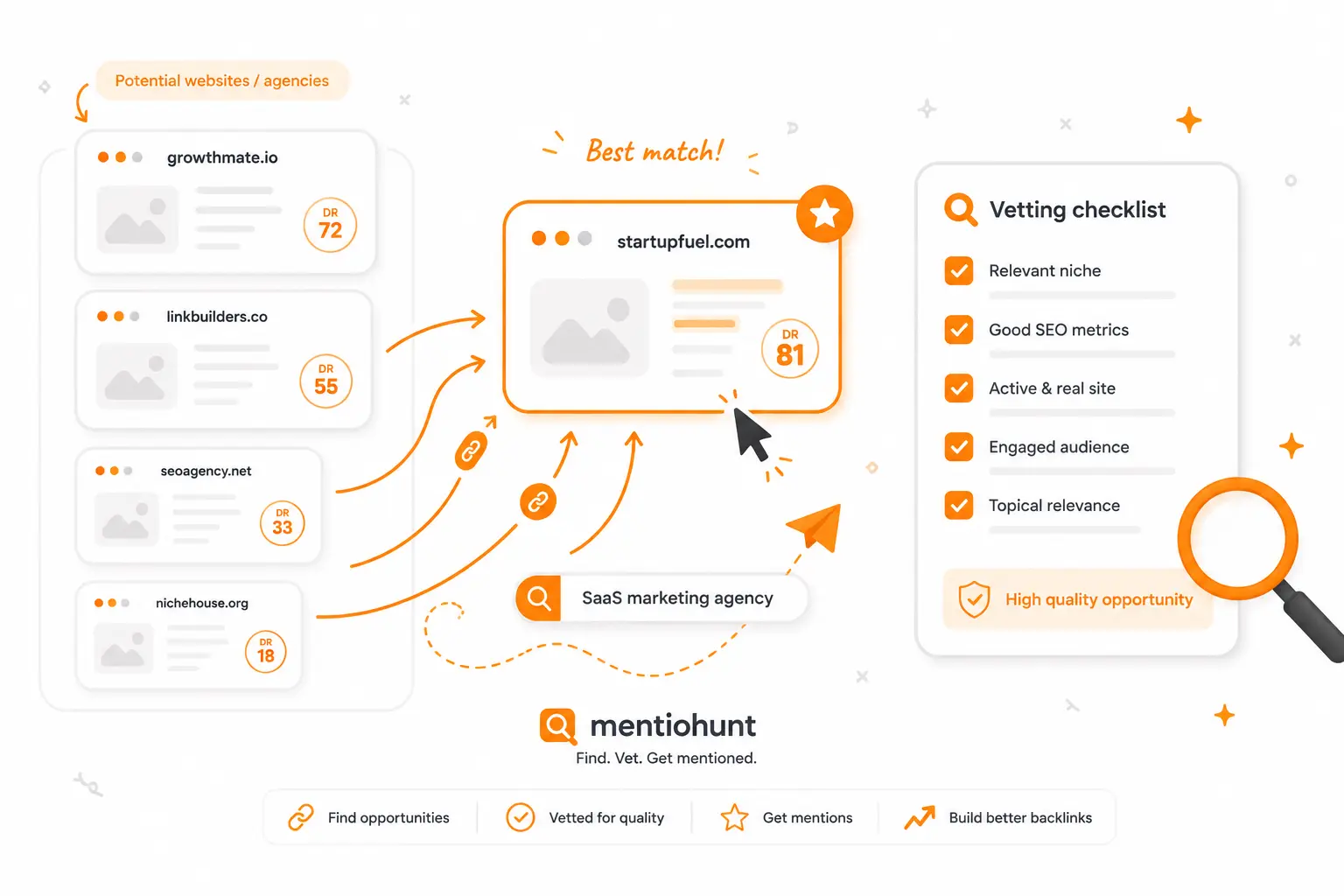
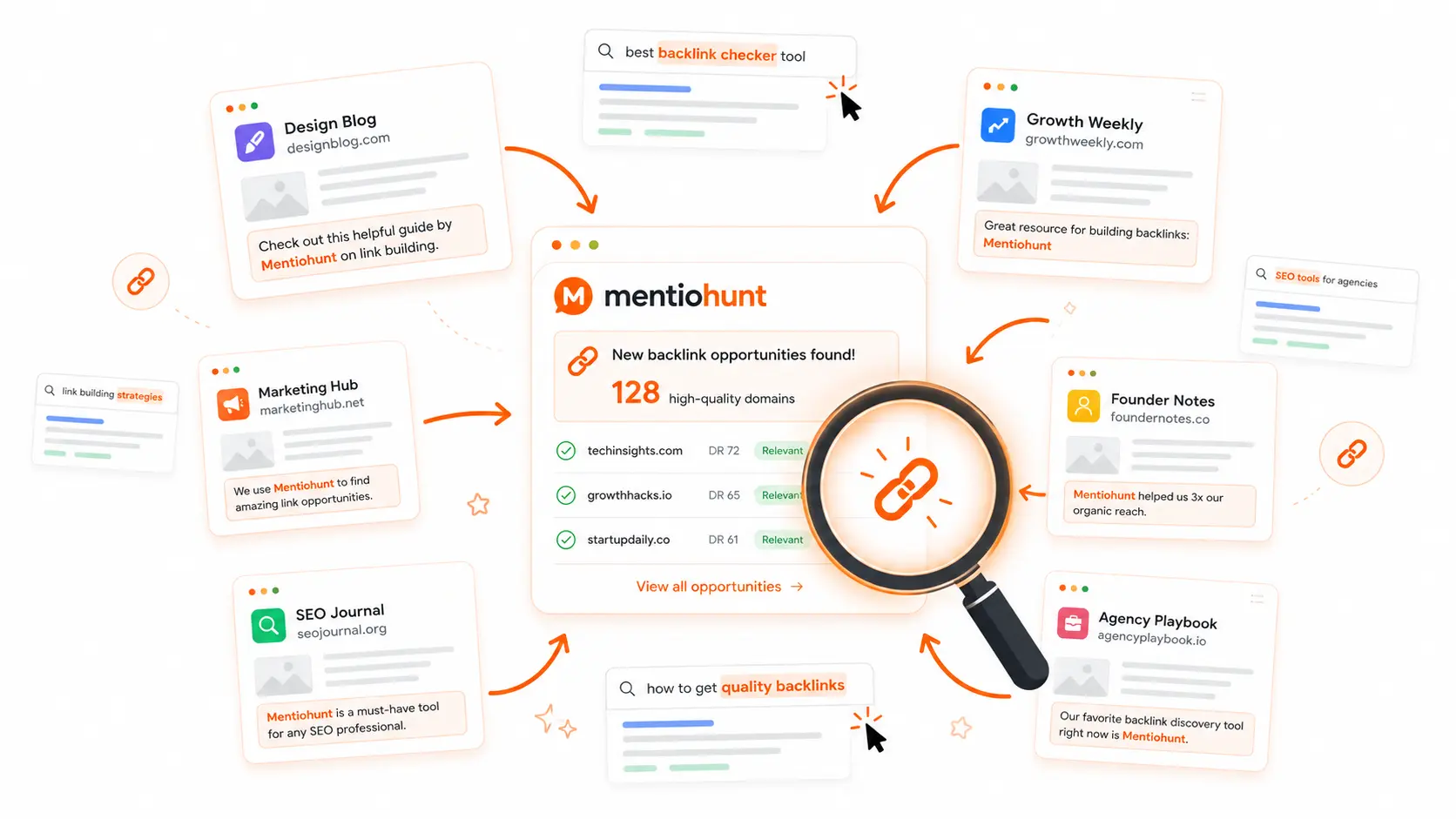
Mentiohunt supports this workflow by using your website, competitors, target keywords, and priority pages to build a queue across competitor backlinks, unlinked mentions, listicles, resource pages, and broken links. Each opportunity includes a fit rationale, contact context, and outreach sequence. Whether you use managed automation or a spreadsheet, the principle is the same: build a queue, not a random list.
What Counts as a Good Backlink Opportunity?
A backlink opportunity is not just “a website that could technically link to you.” That definition creates noise.
A useful backlink opportunity has four types of fit:
- Topic fit: the site covers your market, problem, audience, or adjacent category.
- Page fit: the specific page has a natural place where your resource could help.
- Audience fit: the readers would reasonably benefit from your product, article, tool, data, or guide.
- Outreach fit: you can explain the value in one or two clear sentences.
Third-party authority metrics such as Domain Authority, Domain Rating, URL Rating, Spam Score, Trust Flow, and similar scores can help with prioritization. But they are proxies, not the goal. A relevant mention from a focused industry blog can be more useful than a link from a generic site with a bigger score and no audience overlap. For a refresher on what actually makes a backlink worth having — relevance, editorial context, placement — this link building basics guide covers the fundamentals. And once a placement actually goes live, confirm it's dofollow rather than assuming — the free dofollow backlink checker scans the page and tells you in seconds.
Before adding a prospect to your queue, ask:
| Question | Why it matters |
|---|---|
| Is the site relevant to your category or audience? | Relevance is the foundation of a link that makes sense. |
| Is the specific page relevant? | A good domain does not save a bad page fit. |
| Does the page already link to external resources? | Pages that never link out are harder to pitch. |
| Is there a clear reason to mention your page? | Outreach works better when the angle is obvious. |
| Would the link help readers? | If the answer is no, the pitch is probably weak. |
| Are there spam signals? | Avoid link farms, thin guest post sites, and pages with no real traffic or editorial standards. |
The best opportunities usually feel obvious once you see them. The page is missing a current statistic. A listicle mentions three competitors but not you. A resource page covers your exact topic. A journalist cited an old report and you have newer data. That is the kind of fit you are looking for.
Step 1: Pick the Pages Worth Building Links To
Founders often start by asking, “How do I get links to my website?” A better question is, “Which pages on my website deserve links?”
Not every page is a good outreach target. Your homepage may matter, but many editors do not want to link to a generic homepage unless there is a strong product or brand reason. Blog posts also vary. A thin opinion post is harder to pitch than a useful, specific resource.
Start with pages that give another site a reason to cite you:
- Original research or data reports
- Benchmark studies
- Free tools
- Templates, calculators, or checklists
- Deep how-to guides
- Comparison pages with a clear point of view
- Glossaries or definitions that are genuinely better than what already ranks
- Visual assets, diagrams, or useful graphics
- Product-led educational content that solves a specific problem
The research behind this article shows that content pieces are a major engine for backlink generation, and data-led content is especially strong for digital PR. That tracks with what founders see in practice: people link when your page helps them support a claim, explain a concept, recommend a tool, or improve their own article.
Create a short list of 3-5 pages you want to promote. For each page, write down:
- The target reader
- The problem it solves
- The category it belongs to
- The competitor pages it replaces or improves on
- The outreach angle someone else would care about
This prevents vague prospecting. You are not looking for “backlinks.” You are looking for places where a specific page fits.
Step 2: Run Competitor Link Gap Analysis
Competitor link gap analysis is one of the fastest ways to find backlink opportunities because it starts from proven behavior.
If a site links to two or three competitors, mentions competing products, or cites a competitor’s guide, that site has already shown interest in your space. You still need a good reason to reach out, but you are not starting from zero.
There are two useful levels of analysis.
Domain-Level Link Gap Analysis
At the domain level, you compare your site against competitor domains and look for referring domains that link to them but not you.
You can do this with backlink tools such as Ahrefs, Moz, Semrush, or similar platforms. If you're weighing whether a full SEO platform is worth it just for backlink prospecting, see the best Ahrefs alternative for founders and the best Semrush link building alternative.
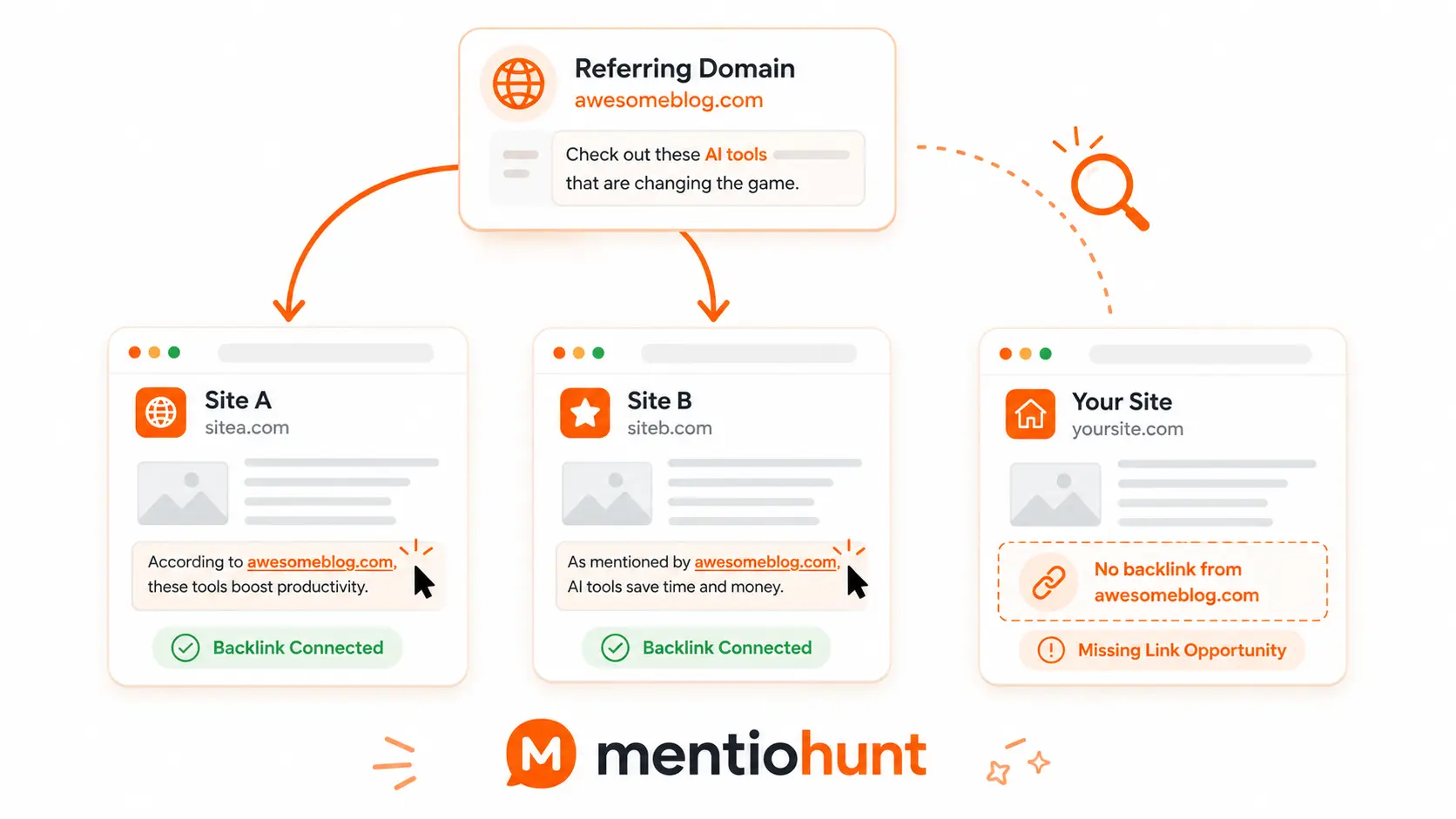
Look for patterns:
- Industry blogs linking to several competitors
- Startup directories listing similar companies
- “Best tools” pages that include competitors
- Partner pages or integration pages
- Podcasts, interview sites, or founder profile pages
- Review sites and comparison hubs
- Niche publications that cite competitor research
Do not export 1,000 rows and call it a strategy. Pull the top prospects into a smaller working queue.
Page-Level Link Gap Analysis
Page-level analysis is more focused. Instead of asking “who links to this competitor?” ask “who links to this exact competitor page?”
For example:
- A competitor’s “state of the industry” report
- A free calculator or tool
- A “best software” listicle
- A glossary definition
- A comparison page
- A guide ranking for your target topic
Then inspect why each site linked.
Did they cite a statistic? Recommend a tool? Use a definition? Embed a graphic? Link to a resource list? Once you understand the reason, you can decide whether you have a legitimate replacement or addition angle.
Use a simple table like this:
| Competitor page | Linking page | Why they linked | Your angle | Priority |
|---|---|---|---|---|
| Competitor report | Blog post on market trends | Needed a recent statistic | Offer newer or more specific data | High |
| Competitor tool page | “Best tools” listicle | Product recommendation | Suggest your product if it fits the category | Medium |
| Competitor guide | Resource page | Helpful educational resource | Share your more current guide | High |
| Competitor definition | Glossary article | Explains a term | Offer a clearer definition or visual | Low |
For a quick free starting point, the free competitor backlink gap analysis shows which sites link to your competitors but not to you — no paid tool subscription required.
This is where Mentiohunt can help if you do not want to run prospecting entirely from a spreadsheet. You can provide article URLs or a sitemap, competitors, keywords, and product context. The useful part is not just finding domains. It is seeing why an opportunity might fit and what the outreach angle could be.
Step 3: Use Google Search Operators for Manual Prospecting
Automated backlink tools are useful, but manual Google searching still finds grassroots opportunities that tools can miss: niche resource pages, small directories, community-curated lists, contributor pages, and specific blogs in your category.
Use search operators to narrow the web around intent.
| Opportunity type | Search examples |
|---|---|
| Resource pages | "keyword" "resources", intitle:resources "keyword", "keyword" "helpful resources" |
| Listicles and tool pages | "best [category] tools", "top [category] software", "[category] tools for startups" |
| Directories | "industry" "business directory", "startup" "directory", "AI tools" "directory" |
| Guest posts | "keyword" "write for us", "keyword" "guest post", inurl:guest-post "keyword" |
| Contributor pages | "keyword" "contributing writer", "keyword" "submit an article" |
| Alternatives pages | "competitor" "alternatives", "competitor" "competitors", "sites like competitor" |
| Review pages | "competitor" "review", "best competitor alternatives" |
For directory prospecting specifically, the free directory submission sites scan can surface relevant directories for your niche without manual searching, or browse the full startup directory list sorted by authority and pricing. For broader website and blog prospecting, this tool to find backlink opportunities takes your URL and surfaces relevant sites, blogs, and resource pages where a link to your product would be a strong fit.
The warning: search operators can surface a lot of low-quality sites. A page saying “write for us” is not automatically a good opportunity. Many guest post sites are thin, over-monetized, or built mainly to sell links.
Qualify every prospect before outreach. Look at the site’s content quality, topic focus, organic visibility, editorial standards, outbound link patterns, and whether real people appear to run the publication.
Step 4: Find Resource Pages and Listicles
Resource pages and listicles are often strong founder-friendly backlink opportunities because they already have link intent.
A resource page exists to curate helpful links. A listicle exists to compare or recommend tools, products, examples, or resources. Your job is not to convince the editor that links are useful. Your job is to show why your page belongs.
Resource Page Workflow
Search for pages like:
"startup marketing" "resources"intitle:resources "link building""SaaS marketing tools" "resources""founder resources" "marketing tools"
Then review:
- Is the page current?
- Does it link to external websites?
- Are the existing resources high quality?
- Is there a missing category your resource fills?
- Is there a named editor, company, or maintainer?
Your pitch should be simple: you found their resource page, noticed a relevant section, and thought your guide/tool/report could be useful for readers because of a specific reason.
Listicle Workflow
Search for pages like:
"best backlink tools""top outreach tools for startups""best SaaS marketing tools""best tools for founder-led sales"
Listicles are especially useful if competitors are already included. But do not pitch every “best tools” article. Prioritize pages where:
- Your product genuinely fits the category
- The article is maintained or recently updated
- The author includes newer tools
- There is a gap in the current list
- Your positioning is distinct from the listed options
For Mentiohunt, for example, a broad “best SEO tools” list may be too generic. A page about founder-led distribution or backlink prospecting for startups would be a better fit.
Step 5: Convert Unlinked Mentions
Unlinked mentions are one of the cleanest backlink opportunities because the hard part has already happened: someone already decided your brand, product, founder, or research was worth mentioning.
An unlinked brand mention is any public page that names your company, product, founder, research, image, or proprietary phrase without linking to the relevant source on your site. The best candidates are editorial mentions where adding a link genuinely helps the reader verify the reference or learn more—not incidental mentions, scraped copies, or forum spam.
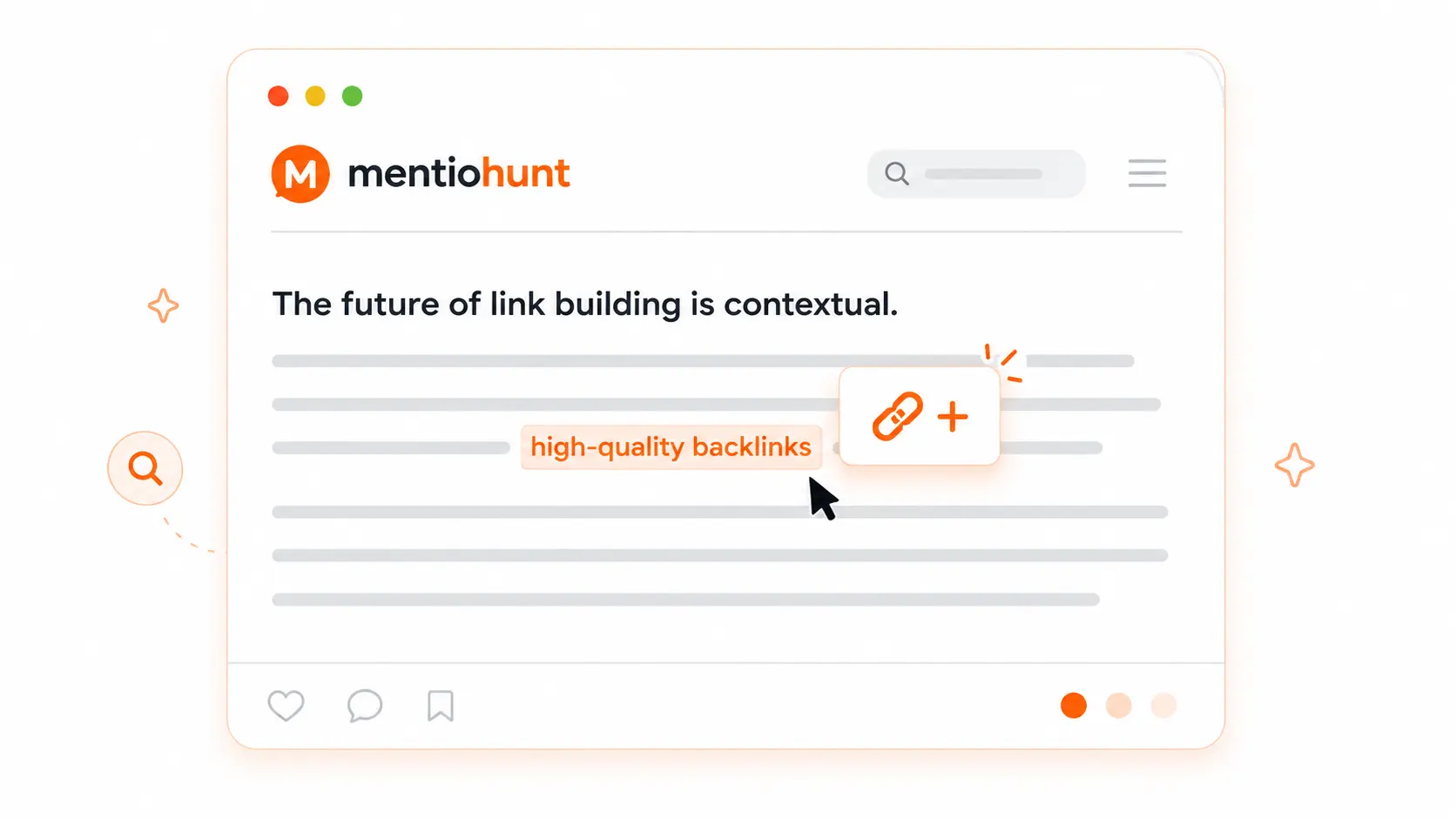
The workflow is straightforward:
- Search for your brand name, product name, founder names, report names, and unique phrases from your content.
- Exclude your own domain from results.
- Check whether the mention links to your site.
- Prioritize editorial mentions on relevant pages.
- Send a short note asking whether they can make the mention clickable for readers.
Example search:
"Your Brand" -site:yourdomain.com
"Founder Name" "Your Brand" -site:yourdomain.com
"Name of Your Report" -site:yourdomain.com
Keep the outreach low-pressure. You are not asking them to rewrite the article. You are asking whether they can link the existing mention so readers can find the referenced source.
Who to contact and what to say
Do not email a generic contact@ address if you can avoid it. In order of who is most likely to act: the article's author (most context, can usually edit directly), then the editor (useful when the author is a freelancer who no longer manages the page), then the webmaster or SEO manager as a last resort. Use the byline, check LinkedIn, or use Hunter.io to find an email by domain.
Keep the note under 100 words, reference the specific article, and make one soft ask — not four paragraphs about how great their blog is. Practitioner-reported conversion rates on this tactic run 30–55% on positive mentions, among the highest of any link-building method, because the site already chose to reference you before you ever reached out.
Prioritizing which mentions are worth pursuing
Not every mention deserves outreach time. Score each one on domain authority, topical relevance, estimated page traffic, and sentiment — a DR 30 site with real topic overlap outperforms a DR 70 site with none. Skip negative coverage, major editorial sites with no-link-out policies, thin low-traffic pages, and spam or link-farm sites.
| Mention type | Conversion probability | Effort |
|---|---|---|
| Positive product review without link | High | Low |
| Tool listicle without link | High | Low |
| Image embed without attribution | Medium–high | Low |
| News or press coverage without link | Medium | Low–medium |
| Directory listing without link | Medium | Low |
| Founder name in editorial | Medium | Low–medium |
| Forum or community thread | Low | Medium |
For real reply-rate data behind conversion patterns like these, see Mentiohunt's link building outreach statistics.
Unlinked mentions also matter because search is becoming more brand-aware. One widely cited Ahrefs analysis of 75,000 brands found unlinked mentions correlate with AI Overview inclusion roughly three times more strongly than backlink count — though the study covered brands with Domain Rating above 40 and measured AI Overviews specifically, not classic blue-link rankings, so treat it as a directional signal rather than proof Google's core algorithm counts mentions directly.
That does not mean every mention will improve rankings or AI visibility. But it does mean founders should pay attention to where their brand is being discussed, even when the link is not there yet. The same attention matters for AI-generated answers — ChatGPT and similar tools cite sources based on trust signals that closely mirror the ones that produce unlinked mentions. For a focused playbook on that surface, see how to get backlinks from ChatGPT.
Community platforms are common sources of unlinked mentions. For platform-specific playbooks, see how to get backlinks from Reddit and how to get backlinks from Quora. For B2B professional outreach that turns LinkedIn connections into editorial links, see how to get backlinks from LinkedIn.
For editorial mentions from news publications, see how to get backlinks from news websites. For authoritative editorial citations that compound over time, see how to get backlinks from Wikipedia. For AI citations and getting your pages retrieved and cited inside ChatGPT answers, see how to get backlinks from ChatGPT. For a visual-search channel that drives referral traffic even though the links are nofollow, see Pinterest backlinks.
Step 6: Use Broken Link Building Carefully
Broken link building is simple in theory: find a dead page that other sites still link to, create or identify a better live replacement, and ask those sites to update the broken link.
In practice, it takes more work than most founders expect.
Use it when the broken page is highly relevant and your replacement is genuinely useful.
The workflow:
- Find broken pages in your niche using SEO tools, browser extensions, or backlink analysis.
- Check which websites still link to the dead page.
- Review what the dead page used to contain, if possible.
- Create or match a live resource that solves the same reader problem.
- Contact the site owner with a helpful note.
The pitch angle is not “please link to me.” It is “this page currently points to a dead resource; here is a live replacement that may help your readers.”
Broken link building is usually higher effort than unlinked mentions or resource page outreach, but it can work well when you find a dead resource with many relevant referring pages.
If that feels too heavy for the page you want to promote, a lighter supporting move is to repurpose the topic into a distribution asset on a strong platform and use that visibility to earn secondary mentions. See how to get backlinks from Medium for one example of that approach.
Step 7: Check Google Search Console and GA4
Premium SEO tools are helpful for competitor research, but Google Search Console and GA4 show what is already happening on your own site.
Use Google Search Console for Link Signals
In Google Search Console, open the Links report and review:
- Top linking sites: which domains Google sees linking to you
- Top linked pages: which pages on your site attract links
- Top linking text: how other sites describe you
Use this for practical decisions:
- If one guide already attracts links, create more content around that topic.
- If one type of site links to you, look for similar sites.
- If anchor text is strange or spammy, review link quality.
- If your best pages have no links, add them to your prospecting queue.
The research file emphasizes that GSC helps you understand how Google sees your backlink profile. For founders, the value is not just monitoring. It is learning which pages and topics are already linkable.
Revisit this report on a schedule, not just once. Links decay: pages get redesigned, sections get removed, sites shut down, and a meaningful share of backlinks break within a year of being placed. A quarterly recheck of the Links report catches lost links worth re-pitching, not just new ones worth building.
Use GA4 for Referral Quality
In GA4, go to traffic acquisition and filter for referral traffic. Then ask:
- Which referring sites send engaged visitors?
- Which links bring people who view multiple pages?
- Which referrals lead to signups, demos, trials, or meaningful actions?
- Which referring domains could become deeper partnerships?
Not every valuable backlink sends immediate traffic. But referral engagement is a strong signal for founder-led distribution. If a niche blog sends five highly engaged visitors, that may be a better relationship to develop than a generic site that sends none.
Turn good referral sources into follow-up opportunities:
- Offer a guest article if there is a clear fit.
- Share a new resource with the same editor.
- Suggest a deeper collaboration.
- Look for similar sites in the same niche.
Step 8: Create Linkable Assets with Digital PR Potential
Some backlink opportunities are found. Others are created.
Digital PR and data-led content work because they give publishers something cite-worthy. Journalists, bloggers, analysts, and industry writers constantly need statistics, examples, benchmarks, and expert commentary.
Founder-friendly linkable assets include:
- A small “state of the market” report
- A survey of customers or practitioners
- A benchmark based on public data
- A teardown of industry trends
- A curated dataset
- A calculator or free tool
- Expert commentary on a timely topic
- A visual map of a category
You do not need a huge research team. A narrow, credible dataset is better than a broad, vague report.
What we see in the Mentiohunt opportunity queue: Pages that surface most often as link targets from resource page and competitor gap searches share a clear pattern — they answer a specific question with original data, they include an embed-ready asset (table, free tool, or visual), and their topic is narrow enough that an editor can cite them without qualification. Generic category pages rarely generate strong link fit signals regardless of domain authority. The thinnest useful dataset beats the broadest vague report every time.
For example:
- A backlink prospecting product could publish “The Most Common Placement Patterns Across SaaS Link Campaigns.”
- A backlink prospecting product could publish “How Often SaaS Listicles Mention the Same Tools.”
- A support tool could publish “Response Time Benchmarks Across 100 SaaS Companies.”
The outreach angle is stronger because you are not just asking for attention. You are offering a source.
Expert quote platforms and journalist request communities can also be useful. The key is to respond with a specific point of view, not generic commentary. Your quote should sound like it came from someone who has done the work. For a full Digital PR playbook covering data campaigns, journalist sourcing, and newsjacking, see how to get backlinks from news websites.
Step 9: Score and Prioritize Your Backlink Opportunities
The easiest way to waste time is to treat every prospect equally.
Most raw prospect lists are worse than they look. Whether the list comes from a competitor gap export, a batch of Google search-operator results, or a sitemap-driven prospecting run, a large share of entries typically fail a baseline quality bar once you actually check topical fit, editorial standards, and whether the site looks maintained. That is normal, not a sign you searched wrong. It is exactly why scoring matters more than list size.
Use a simple scoring model. It does not need to be perfect. It just needs to help you decide what to do next.
| Factor | Score 1 | Score 3 | Score 5 |
|---|---|---|---|
| Relevance | Barely related | Adjacent category | Direct category/audience fit |
| Page fit | No obvious placement | Possible mention | Clear natural placement |
| Authority signal | Low quality or unknown | Decent site | Trusted site in niche |
| Referral potential | Unlikely to send readers | Some audience overlap | Strong audience overlap |
| Link intent | Rarely links out | Sometimes links out | Page is built to cite resources |
| Outreach angle | Vague ask | Reasonable angle | Clear reader benefit |
| Effort | Hard to execute | Moderate | Easy next step |
| Risk | Spam signals | Needs review | Clean editorial site |
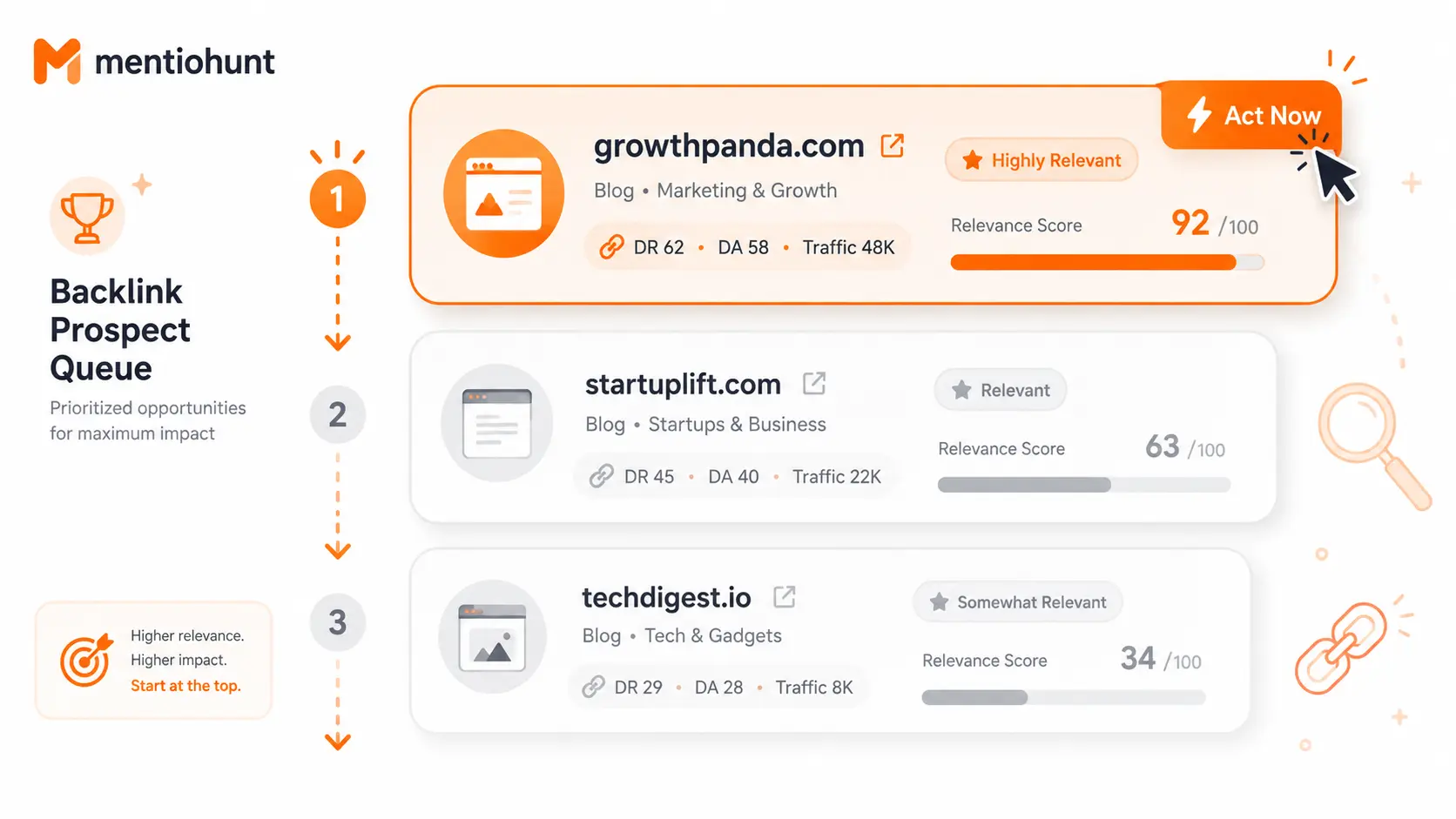
Then label each opportunity:
- Act now: high relevance, clear page fit, strong outreach angle
- Research more: promising, but needs contact or context review
- Save for later: decent fit, not urgent
- Skip: weak relevance, spam signals, or no believable reason to link
This is the queue mindset. You are not trying to collect the biggest list. You are trying to create a repeatable flow of qualified next actions.
Mentiohunt's backlink opportunity queue is built around that idea: opportunity discovery, fit rationale, contact context where available, and outreach prep in one place. It does not guarantee links, but it does schedule outreach automatically through a prospect's first reply. You monitor the queue and cancel anything that isn't a fit, then take over the conversation when someone responds.
For a real example of this five-method rotation running end to end, see how Elevation Vibe earned 3 backlinks in its first month with no prior backlink profile.
Which Method to Prioritize, Based on Where Your Site Is
Not every method deserves equal time this week, and the right starting point depends on your site's current authority, not just what feels most familiar.
| Method | Typical effort | What drives yield | Best when |
|---|---|---|---|
| Unlinked mention conversion | Low | Highest acceptance rate of any method — the mention already exists | Your brand, product, founder, or research gets mentioned at all |
| Resource page outreach | Low-medium | Pages built to link out convert better than cold pitches | You have a genuinely useful, specific resource to offer |
| Competitor link gap | Medium | Depends on how close a competitor you are; sites linking to 2-3 competitors convert best | You have identifiable competitors with real referring domains |
| Broken link building | High | Can convert well when the dead resource is highly relevant, but needs more research per prospect than other methods | You find a dead page with several relevant referring sites |
| Digital PR / journalist requests | Medium-high | Wide range depending on response speed and quality of the quote or data offered | You can respond fast with something specific and citable |
Site stage changes the calculus:
- New or low-authority site: Start with unlinked mentions and resource pages. Neither depends on your own domain strength — the ask depends on relevance and whether the mention or resource gap already exists.
- Established site with some traction: Competitor link gap analysis becomes more useful once you have real competitors worth comparing against, and broken link building starts to justify the extra research time.
- Higher-authority site: Digital PR and data-led content (see Step 8) tend to return the best ratio of effort to placement quality, since editors are more willing to cite a site that already carries credibility.
These are directional, not fixed thresholds. A newer site with a genuinely excellent original dataset can still land strong digital PR placements. Use domain strength as one input to prioritization, not a hard gate.
Step 10: Prepare Outreach Around Fit, Not Flattery
Most bad outreach fails before the email is sent because the opportunity was never real.
If the page has no reason to mention you, better copy will not fix it. If the reason is strong, the email can be short.
Use this checklist before sending:
- Reference the exact page.
- Name the section, claim, list, or resource you are responding to.
- Explain what is missing, outdated, broken, or incomplete.
- Offer one specific resource.
- Explain why it helps readers.
- Keep it short.
- Make the next action easy.
- Review the target context and AI-generated draft when your workflow allows it.
- If you use a dedicated outreach platform, see how Mentiohunt compares to Ahrefs, Semrush Link Building Tool, the best Pitchbox alternative, Respona, the best BuzzStream alternative, BacklinkGPT, and Postaga for founder-scale prospecting.
A simple example:
Hi Jamie,
I was reading your page on startup launch resources and noticed the section on places founders can submit their product.
We recently published a startup directory list that covers free and paid submission sites, review notes, and which directories are still active. It may be a useful addition for readers who are trying to find early distribution channels.
Here it is: https://mentiohunt.com/free-tools/startup-directories
Either way, thanks for putting the resource together.
For unlinked mentions, make it even shorter:
Hi Avery,
Thanks for mentioning Mentiohunt in your article on founder-led distribution tools. Would you be open to linking the mention to https://mentiohunt.com so readers can find the referenced page more easily?
Appreciate it.
Do not pretend to be a longtime fan if you are not. Do not write four paragraphs about how amazing their blog is. Be useful, specific, and easy to evaluate.
A Simple Weekly Backlink Prospecting Routine
Backlink prospecting works better as a weekly habit than a quarterly scramble.
Here is a lightweight routine for founders.
The 30-Minute Version
Use this when you are busy but want to keep momentum.
- Review 5-10 new prospects from competitor gaps, Google searches, or Mentiohunt.
- Check for obvious resource page, listicle, or unlinked mention opportunities.
- Score each opportunity quickly.
- Pick the top 2-3.
- Prepare short, specific outreach.
The 2-Hour Version
Use this when backlink prospecting is a real focus for the week.
- Pick one page you want to promote.
- Run competitor page-level backlink research.
- Search Google for resource pages and listicles around that topic.
- Check GSC for linked pages and linking domains.
- Check GA4 for referral sources with engaged visitors.
- Score the best prospects.
- Prepare outreach for the highest-fit opportunities.
- Save lower-priority prospects for later.
If you do this consistently, you will learn which pages earn attention, which topics attract links, and which outreach angles feel natural.
Conclusion: Build a Queue, Not a Random List
Learning how to find backlink opportunities is not about chasing every site with an authority score. It is about finding places where your page belongs.
Start with linkable pages. Study competitor links. Use Google operators to find resource pages, listicles, directories, and contributor opportunities. Watch for unlinked mentions. Use broken link building when the replacement is strong. Review GSC and GA4 to learn from your own data. Create data-led assets when you want stronger editorial reasons to be cited. Then score everything before you pitch.
The practical output should be a queue of qualified opportunities with a clear next action.
If you want discovery and outreach to run without building campaigns yourself, Mentiohunt checks those opportunity types daily, explains the fit, and runs outreach through the first reply. It will not guarantee backlinks. It reduces the time spent sorting noise and operating the initial outreach workflow.
FAQs
What is a backlink opportunity?
A backlink opportunity is a website, page, mention, or relationship where linking to your resource would make sense for the reader. Good opportunities have topic fit, page fit, audience fit, and a clear outreach angle.
How do I find backlink opportunities for free?
Start with Google search operators, Google Search Console, and GA4. Search for resource pages, listicles, directories, guest post pages, competitor alternatives, and unlinked brand mentions. Use GSC to see who already links to you and GA4 to find referral sources that send engaged visitors.
How do I find competitors’ backlinks?
Use backlink tools such as Ahrefs, Moz, Semrush, or similar platforms to review competitor referring domains and page-level backlinks. Look for sites that link to multiple competitors, then inspect why they linked and whether your resource offers a relevant addition or replacement.
Are resource pages still good backlink opportunities?
Yes, when they are relevant, maintained, and editorially curated. Resource pages are useful because they already exist to link to helpful resources. Avoid low-quality pages that look like link farms or have no real topic focus.
What are unlinked brand mentions?
Unlinked brand mentions are places where a site mentions your company, product, founder, or research but does not link to you. They are often good outreach opportunities because the site has already referenced you. A short request to make the mention clickable can be enough.
Is broken link building still worth it?
Broken link building can be worth it when the dead resource is highly relevant and your replacement is genuinely helpful. It usually takes more effort than unlinked mention outreach or resource page prospecting, so prioritize broken links with strong topic fit and multiple relevant referring pages.
How should I prioritize backlink prospects?
Score prospects by relevance, page fit, authority signal, referral potential, link intent, outreach angle clarity, effort, and risk. Focus first on opportunities where the reason to link is obvious and the site is relevant to your audience.
Can Mentiohunt get backlinks for me?
Mentiohunt helps you find and prioritize backlink opportunities, understand fit rationale, surface contact context when available, draft outreach, and send it automatically through a prospect's first reply. It does not guarantee backlinks, placements, replies, rankings, or community acceptance. It does not post on your behalf, and it does not continue the conversation after a prospect responds — that part is yours, from your own mailbox.

Founder at Mentiohunt. Building distribution tools for founders and small marketing teams. Writes about backlink building and founder-led growth.
@nicolasmore_Turn this guide into a weekly opportunity queue.
Mentiohunt helps founders turn article URLs, competitors, keywords, and product context into qualified backlink opportunities with fit rationale and outreach prep.