Prefer AI? Summarize this with ChatGPT,
Claude,
Google AI Overview, or
Perplexity.
Most founders approach Wikipedia like a directory submission. They create an account, add a link to a relevant article, and wonder why it disappears within the hour.
Wikipedia is not a directory. It is an editorial system run by thousands of volunteer editors who are specifically trained to catch promotional intent. Getting a link that sticks requires acting like a researcher, not a marketer.
The reward is worth the effort. Wikipedia links are nofollow, but their value runs deeper than link juice — they influence how Google models your brand's authority, how AI systems cite your content, and how much high-intent referral traffic lands on your site.
Quick answer: Wikipedia links are
nofollowbut influence Google'spagerankNSauthority model, feed the Knowledge Graph, and appear in LLM training data. The only approach that works: warm a real account with 10–20 unrelated edits first, find dead links or[citation needed]tags in your niche, supply a credible research page as the replacement, and use the{{Cite web}}template correctly.
Why Wikipedia backlinks are different
Most link-building targets give you a placement. Wikipedia gives you a citation in a document that Google treats as a primary trust node.
A few specifics:
- All Wikipedia links are
nofollow, which means they don't pass direct ranking credit in the traditional sense. But Google's 2024 search algorithm leak surfaced a metric calledpagerankNS— a signal that uses highly trusted domains like Wikipedia as seed sites to calibrate the authority of everything else in the index. A Wikipedia citation shapes how Google weighs your domain, even without passing explicit link juice. - Wikipedia feeds the Knowledge Graph. Entries and citations on Wikipedia map directly to Google's entity system, which powers Knowledge Panels and AI Overview answers. Being cited in the right article increases the chance your brand appears as a recognized entity — not just a URL.
- Wikipedia is a core training dataset for LLMs. As AI-driven search grows, a presence in Wikipedia signals to search systems that your content is factually grounded and editorially vetted.
- Referral traffic is real. High-traffic Wikipedia articles on commercial topics send meaningful clicks to cited sources. These visitors are in research mode — some of the highest-intent readers you'll get.
Three entry points that actually work
1. Dead link replacement
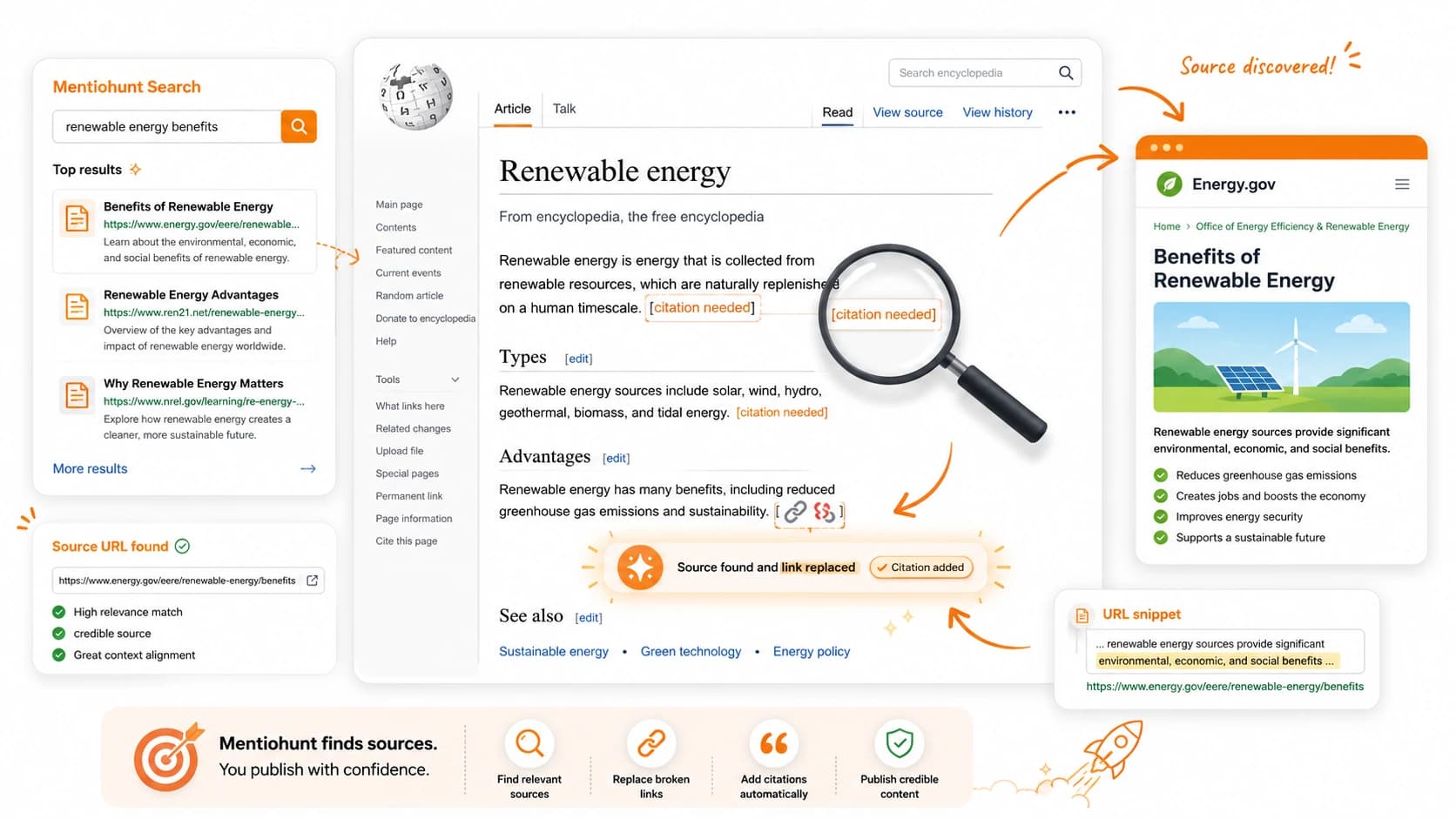
This is the highest-acceptance tactic because the editorial need is already established. When a citation in a Wikipedia article points to a dead URL (404), any editor can replace it — and editors welcome the fix.
Your job is to find articles in your niche where citations have rotted, then provide a replacement that covers the same claim as the original source. The easier you make the editor's verification job, the more likely your replacement survives.
2. "Citation needed" tags
Wikipedia articles often contain statements flagged with [citation needed] markers. These are explicit invitations. If you have original research, a data-backed report, or a credible informational guide that supports the claim, you can supply the missing citation.
This works best when you have proprietary data — a benchmark study, a survey, or industry statistics your site actually published. Opinion pieces and blog posts will be rejected.
3. Stub expansion
Stub articles are short, underdeveloped entries on topics where more depth exists. Expanding a stub by summarizing key facts from deep, credible resources — and citing those resources — is a valid strategy. It requires more editorial effort and a strictly neutral tone, but it can establish your content as a foundational reference in a niche with little existing coverage.
Before you edit: the account warming step
This is where most failed attempts begin.
Wikipedia's editors and automated bots are specifically trained to flag single-purpose accounts (SPAs) — accounts that appear to exist only to insert a particular link or promote a particular domain. A new account that makes its first edit a link to your site will be flagged within minutes.
Before you attempt any link insertion:
- Register an account with a neutral username. No brand names, no SEO-adjacent terms.
- Make 10–20 edits with no links attached. Fix typos, improve grammar, reformat citations, correct dates — in articles completely unrelated to your niche.
- Reach autoconfirmed status: an account at least four days old with at least ten edits. This unlocks semi-protected pages and reduces automated scrutiny.
- For high-stakes citation opportunities, extend the warming period to several weeks. Contribute to multiple WikiProjects across different topic areas.
An account with 50+ edits and a diverse history is treated very differently than an account with three edits — all in the same niche.
Finding opportunities
Google dorks are the fastest starting point:
site:wikipedia.org "dead link" [your keyword]site:wikipedia.org "citation needed" [your keyword]site:wikipedia.org "this article requires additional references" [your keyword]
WikiGrabber lets you enter a keyword and get a filtered list of Wikipedia pages tagged with citation needed or dead link markers — faster than manual searching.
Ahrefs or SEMrush can scan the wikipedia.org domain for broken outbound links. This surfaces broken citations at scale across high-traffic articles.
SEO Minion (browser extension) identifies broken links in real time as you browse any article.
Once you find a dead link opportunity, use the Wayback Machine to retrieve the original page. Your replacement content needs to support the same specific claim the original source was proving — not just be tangentially related.
Worked example: an article on cold email or outreach practices cites a dead 2019 "state of email deliverability" report to support a specific stat — say, average open rates by industry. The Wayback Machine copy shows exactly which number the citation was backing. A replacement only survives review if your page states that same number (or a clearly updated version of it) with its own sourcing — not a generic deliverability guide that happens to mention open rates in passing.
What content Wikipedia will actually accept
Wikipedia editors vet the target URL, not just the edit. Your cited page must look like a credible research resource, not a conversion asset.
What gets accepted:
- Original research with proprietary data
- Industry studies with statistical findings
- Deep informational guides written in neutral, educational tone
- Historical archives with verifiable dates and sources
What gets rejected immediately:
- Product pages or feature comparisons
- Blog posts framed as opinion or advice
- Pages with lead-gen forms, popups, or heavy advertising
- Press releases or announcement posts
If your domain appears on Wikipedia's spam blacklist — which happens after repeated promotional edits — future citations from your site will be automatically blocked.
How to insert the citation correctly
Use the {{Cite web}} template. Complete all fields:
{{Cite web |title=2025 Market Benchmark Report |url=https://example.com/report |website=Industry Research Institute |date=2025-01-15 |access-date=2026-05-16}}
Skipping fields or using redirected URLs increases the chance your edit is reverted on formatting grounds alone.
Write an honest, descriptive edit summary — the short note other editors see when reviewing your change. "Added citation for social media statistics from 2025 industry report" works. "Added link" is suspicious. "Great resource on this topic" reads as promotional.
If you have a conflict of interest (you work for the organization being cited), do not edit the article directly. Post on the article's Talk page instead: explain the proposed citation, disclose your affiliation, and let community editors decide. This is the protocol Wikipedia actually asks for, and it's far more durable than a direct edit that gets caught and reversed.
What to avoid
- Editing directly with a new account. Bots like ClueBot NG and XLinkBot pattern-match on account age, edit count, and domain novelty. A new account linking to a commercial domain gets flagged within minutes and the domain logged for future scrutiny.
- Commercial-looking target pages. If the cited URL has a CTA above the fold, a lead-gen form, or product pricing, it fails Wikipedia's Reliable Sources standard. Editors check the linked page, not just the edit diff.
- Edit wars. If your link is removed, diagnose why before re-adding. Reverting a removal without Talk page discussion is treated as disruptive editing — three reverts in 24 hours triggers an automatic block under the three-revert rule.
- Exact-match anchor text. Wikipedia's
{{Cite web}}template controls display text. Forcing keywords into thetitle=field looks manipulative and gets flagged. Accurate, descriptive metadata is all that matters.
A repeatable workflow
- Find gaps. Use Google dorks and WikiGrabber to identify dead links and citation-needed tags in your niche.
- Check the original source. Use the Wayback Machine to confirm what claim the dead link was supporting.
- Match your content. Confirm your page makes the same specific factual point — and that it looks like a research resource, not a landing page.
- Make the edit. Use the
{{Cite web}}template with complete fields and a clear edit summary. - Set a watchlist alert. Wikipedia lets you watch pages for changes. Monitor any article you've contributed to so you can respond quickly if your edit is challenged.
- Use the Talk page for contested edits. If an editor flags your addition as COI or promotional, propose on the Talk page rather than re-editing.
The compounding value of a Wikipedia citation
A Reddit backlink lives or dies by thread activity. A Wikipedia citation compounds: it influences search ranking signals, populates AI Knowledge Graph entries, and drives referral traffic indefinitely — as long as the article stays relevant and the page stays live. If you want a more PR-led editorial target, the same research-first mindset applies when trying to get backlinks from Forbes.
The bottleneck is not writing the edit. It's finding the right Wikipedia articles where your content genuinely fits as a citation — before someone else fills the gap or IABot replaces the dead link with a Wayback Machine archive.
Mentiohunt's backlink building surfaces citation-worthy opportunities for your existing content. Add your article URLs, and the system finds relevant placements across the web — including Wikipedia pages where your research fits a documented gap.
Wikipedia is one piece of a broader backlink strategy. For the full picture — finding opportunities across multiple platforms — see how to find backlink opportunities.
This guide was written by the Mentiohunt team. We build tools for founders doing their own link building and community outreach.

Founder of Mentiohunt. Built the company's own backlink pipeline using the same methods covered here — expert quote outreach, journalist sourcing platforms, and citation-worthy assets. Writes about link prospecting and founder-led distribution.
@nicolasmore_Turn platform research into a recurring opportunity queue.
Mentiohunt helps founders turn article URLs, competitors, keywords, and product context into qualified backlink opportunities with fit rationale and outreach prep.