Some of the easiest backlinks you can earn are sitting on pages that already mention you.
Someone reviewed your product. A journalist named your tool in a roundup. A blogger quoted your founder. A directory listed your company. None of them linked. The mention is there — the link is not.
That gap is an unlinked brand mention. Converting it into a backlink is usually the highest-conversion outreach you can run, because the site has already shown interest in your brand. You are not asking someone to care about you. You are asking someone who already mentioned you to make that mention clickable.
This guide covers how to find your unlinked mentions, which ones are worth pursuing, how to write outreach that converts, and what the latest AI search data says about why building your mention profile matters even when you cannot get every link.
TL;DR
- An unlinked brand mention is any page that names your brand, product, or founder without a hyperlink back to you
- Google's spokespeople say they do not directly affect organic rankings — but Ahrefs' 2025 study of 75,000 brands found a strong correlation with AI Overview inclusion (more on the caveats below)
- Find them with Google search operators, Google Alerts, or Ahrefs Content Explorer
- Prioritize by domain authority, topical relevance, page traffic, and mention sentiment
- Outreach conversion rates run 30–55% in practitioner reports — among the highest of any link-building tactic
- Set up ongoing monitoring so you catch new mentions weekly, not months later
What Are Unlinked Brand Mentions?
An unlinked brand mention is any place on the web where someone references your brand, product, founder name, or related asset — without a hyperlink pointing back to your site.
The page passes no link equity. Your domain gets no direct SEO credit from the reference. But the mention is still there, which means one thing: that site's author already thought your brand was worth naming. That is an outreach conversation that starts with social proof already in place.
Types worth tracking
Not every brand reference is worth pursuing as a backlink. These are the variants that show up most often and convert best:
- Brand name mentions — your company name in an article, tool roundup, or editorial piece
- Product name mentions — the name of a specific feature, product line, or SaaS tier
- Founder or executive name mentions — quotes, opinion attribution, or "founders to watch" content
- Image embeds without attribution — someone used your product screenshot, logo, or diagram without linking back
- Domain misspellings — "yourproduct.co" instead of "yourproduct.com," or hyphenated variants
- Slogan or tagline uses — distinctive phrases tied to your brand used without credit
What unlinked mentions are NOT
- Nofollow links — these exist and do have a hyperlink; they just pass no PageRank directly
- Broken links — these once pointed to you and now return a 404; that is link reclamation, a separate workflow
- Previously removed links — also link reclamation, not unlinked mention outreach
The distinction matters for your outreach framing. Broken link outreach explains that a link is broken and offers a fix. Unlinked mention outreach thanks someone for the reference and makes a brief, soft request to make it clickable. Different ask, different tone.
Do They Actually Help SEO? The Honest Answer
This is where most guides either skip past Google's position or dismiss it. Neither approach serves you well.
What Google has said
Google's John Mueller has addressed unlinked brand mentions directly and repeatedly — in 2015, 2018, 2020, 2021, and 2022. The consistent message: unlinked mentions are not used as a direct ranking factor in traditional Google search. Mueller has said that Google is "looking at links" specifically, and that a mention without a link is not equivalent to a mention with one from a rankings standpoint.
Gary Illyes at BrightonSEO in 2019 said something slightly different — that Google looks at "mentions and links" when evaluating content quality — but this statement is frequently over-interpreted. It likely refers to brand search volume and co-citation patterns rather than a simple "your name appears on a page = ranking boost" mechanism.
The Google Patent US 8,682,892, often cited as proof that unlinked mentions help rankings, is widely misread. A Search Engine Journal analysis found the patent most likely refers to branded search queries, not on-page text mentions. Do not lean on it as evidence.
What the Ahrefs data shows — with the right caveats
In 2025, Ahrefs published a Brand Radar study analyzing 75,000 brands. The finding that circulates widely: brand mention volume correlated with Google AI Overview inclusion at a 0.664 Spearman correlation — stronger than the correlation with traditional backlink count.
That is meaningful data. But the methodology matters:
- The study analyzed brands with a Domain Rating above 40 — not new or low-authority sites
- It measured correlation with AI Overviews specifically, not with classic blue-link organic rankings
- Correlation is not causation — brands with more mentions may also have more backlinks, better content, and higher brand search volume
So the Ahrefs study does not contradict Mueller. It measures a different signal in a different system.
The honest take for founders
Pursuing unlinked mentions for the direct link value is still worth it — the conversion rates are good, the outreach is short, and you are building actual backlinks when it works. The AI search angle adds a second reason to take your mention profile seriously: even mentions you cannot convert into backlinks appear to contribute to how language models recognize and surface your brand.
Two good reasons to run this tactic. Neither of them requires you to believe Google is secretly counting mentions in its core ranking algorithm.
How to Find Your Unlinked Brand Mentions
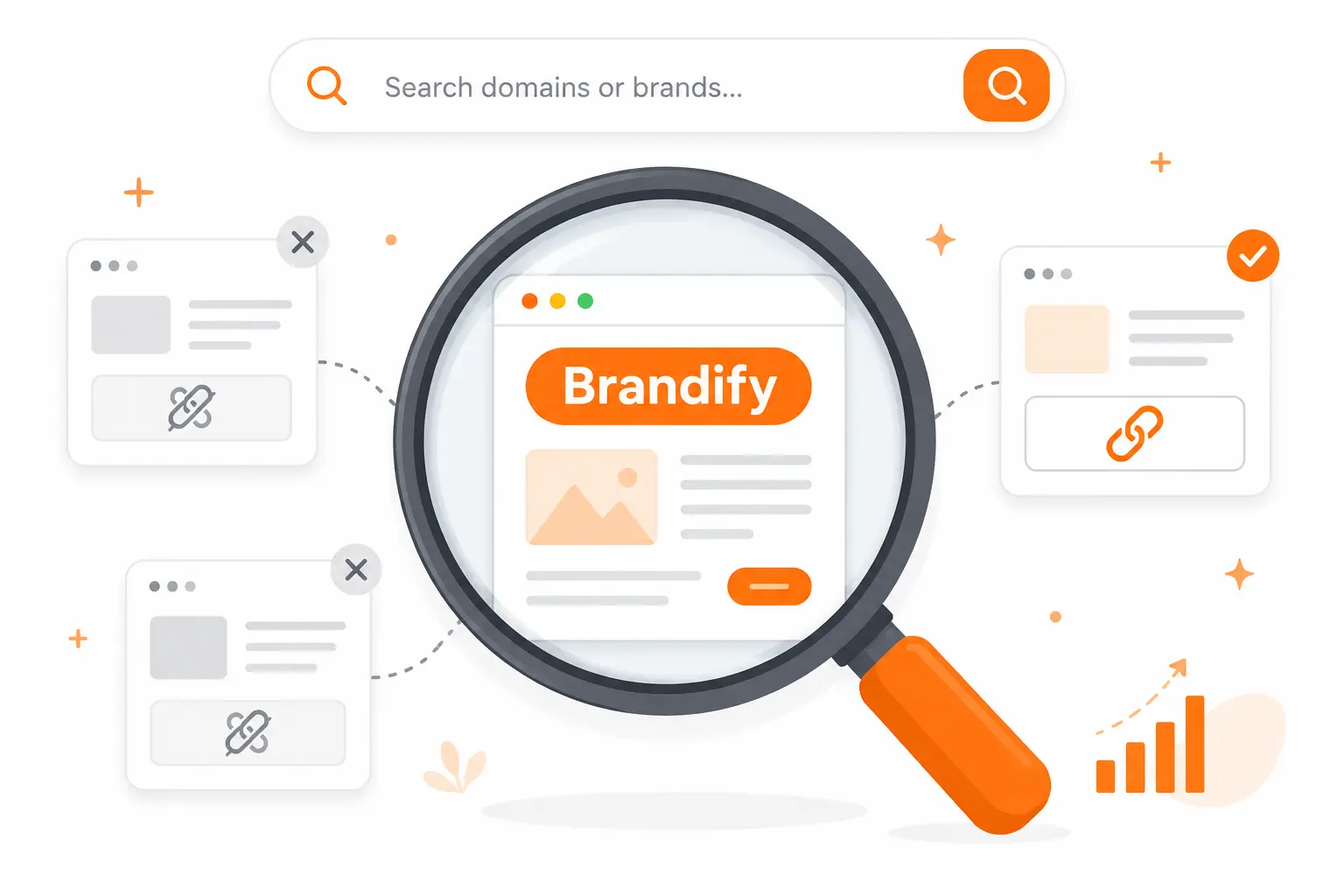
Start free, then layer in paid tools if volume justifies it.
Method 1 — Google search operators (free)
Run a search for your brand name while excluding your own domain:
"your brand name" -site:yourdomain.com
Add variants: your product name, your founder's name, common misspellings. Narrow by recency using Google's tools filter (past month, past year). Open each result and check manually whether the mention includes a hyperlink.
This is slow at scale but costs nothing and is useful for an initial audit or for validating a specific mention you already know about.
Useful operator additions:
"your brand" -site:yourdomain.com -site:twitter.com -site:linkedin.com
"your product name" -site:yourdomain.com
"founder first last" -site:yourdomain.com
Method 2 — Google Alerts (free, ongoing)
Set up alerts for:
- Your brand name (exact match in quotes)
- Your product name
- Your founder's name
- Common misspellings of your brand
Google Alerts sends email notifications when new indexed content matches your query. The coverage is not comprehensive — it misses a lot — but it catches fresh editorial mentions close to publication, which is when outreach converts best. Authors are more likely to add a link when the article is recent.
Use "as it happens" or "once a day" frequency to keep new mentions from aging before you act on them.
Method 3 — Ahrefs Content Explorer (paid, most efficient)
Search your brand name in Ahrefs Content Explorer, then use the "Highlight unlinked domains" filter to flag results that mention you without linking. Sort by DR or estimated traffic to prioritize the strongest prospects.
This is the fastest method for a brand with meaningful content coverage. You can process a large mention backlog in an hour, export the filtered list, and start building your prioritization queue.
Method 4 — Semrush Brand Monitoring (paid alternative)
If your team is already in Semrush, Brand Monitoring surfaces web and social mentions with link-present/absent filtering. The AI search tracking capability is developing; check the current feature set before relying on it for AI mention coverage.
Method 5 — Screaming Frog for link verification
If you have a list of pages you suspect mention you, crawl them in Screaming Frog with a custom search to confirm whether a link to your domain is present. Useful for validating a batch before outreach rather than checking each URL manually.
Bonus: reverse image search
If you have a recognizable logo, product screenshot, or branded visual, run it through Google Images or TinEye. Sites that embedded your image without attribution are often willing to add a link — and image-embed outreach tends to feel natural because you are providing clear attribution context.
If you use Mentiohunt, you can point it at your article URLs or sitemap and it surfaces unlinked mentions as part of your opportunity queue — with a fit rationale already attached to each one, so you are not sorting through raw search results manually.
How to Prioritize Which Mentions to Pursue
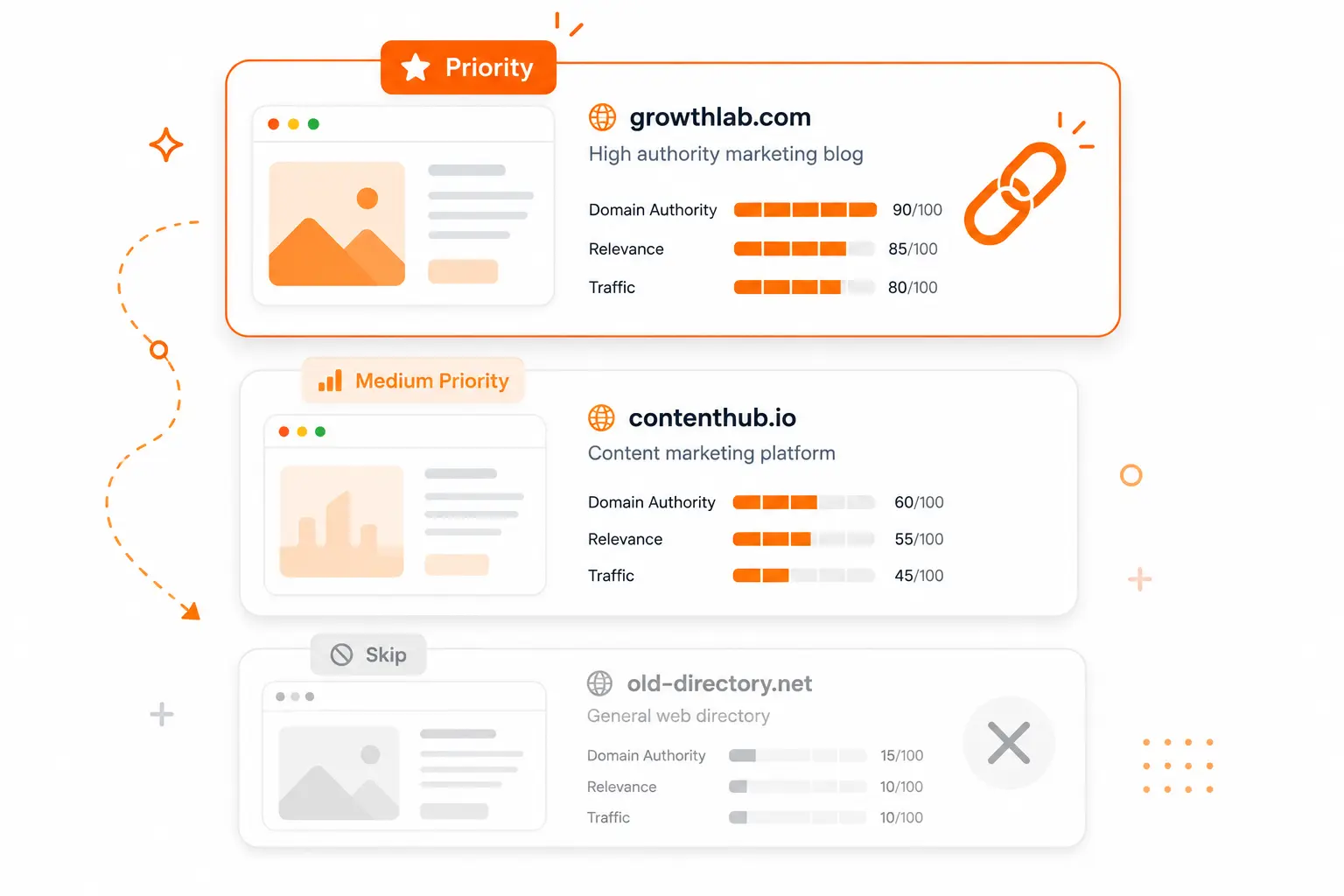
Not every mention is worth your outreach time. A quick scoring pass before you start writing emails pays off.
Scoring criteria
Score each mention across four factors:
- Domain authority (DR/DA): Higher is generally better, but a DR 30 site with strong topic relevance can outperform a DR 70 site with no audience overlap
- Topical relevance: Does the site cover your category, audience, or problem space? A mention on a tangentially related site is worth less than a mention in a publication your target customers actually read
- Estimated page traffic: A high-DR page with no traffic is less valuable than a mid-DR page that sends real referral visits
- Mention sentiment: Positive or neutral mentions convert; negative coverage (a critical review, a "scam" post) almost never does and can make outreach awkward
| Mention type | Avg. conversion probability | Effort to convert |
|---|---|---|
| Positive product review without link | High | Low |
| Tool listicle without link | High | Low |
| News or press coverage without link | Medium | Low–medium |
| Directory listing without link | Medium | Low |
| Founder name in editorial | Medium | Low–medium |
| Forum or community thread | Low | Medium |
| Image embed without attribution | Medium–high | Low |
| Brand name in academic or research context | Low–medium | Medium |
These are directional estimates based on practitioner-reported patterns, not controlled study data.
When NOT to pursue a mention
Skip these categories:
- Negative coverage — do not ask for a link in an article that criticizes your product or company
- Major editorial sites with no-link-out policies — large news organizations often have editorial policies that prohibit adding external links after publication; the response rate is very low and the relationship cost is not worth it
- Low-traffic thin pages — a DR 15 site with one article and no visible audience is unlikely to drive referral value even with a link
- Spam or link farm sites — a link from a low-quality site can be neutral at best; do not spend time on these
- Sites that never link out — check whether the page has any external links at all; some editorial styles don't use them
How to Convert Unlinked Mentions Into Backlinks
Step 1: Find the right contact
Do not email a generic contact@ address if you can avoid it. The right person is:
- The article author — most likely to care and have the ability to edit
- The editor — useful when the author is a freelancer or contributor who no longer manages the page
- The webmaster or SEO manager — last resort; less context on the mention, but can make the edit
Use the byline, check LinkedIn for the author's current contact, or use Hunter.io to find the editor's email by domain. Keep the list short — one contact per mention to start.
Step 2: Write an outreach email that works
The most common mistake in mention outreach is making it about you. The email should frame the link as useful for the reader of that page, not as a favor to your domain.
Keep it under 100 words. Reference the specific article and specific mention. Make one clear, soft ask.
Here is a template for a news article or press coverage mention:
Here is a template for a tool listicle or product roundup:
Step 3: Follow-up strategy
Send one follow-up if you get no response. Wait 5–7 days. Keep it brief — one or two sentences acknowledging they may have missed the first message. If there's still no response after that, move on.
Sending more than two emails for a single mention crosses into spam territory. The relationship cost is not worth the marginal chance of a link.
Realistic conversion rates
Practitioner-reported estimates from community threads and published case studies range from 30–55% average conversion rate on positive mentions (Viral-Impact community data). A LinkedIn case study on a focused mention outreach campaign reported 62%. Neither figure comes from a controlled study — treat them as directional benchmarks, not guarantees.
Conversion rates vary significantly by:
- Freshness of the mention (recent articles convert better)
- Quality of the personalization
- Sentiment of the coverage
- Whether the site is actively maintained
- Whether you can reach the actual author
The key insight: even at the low end of that range, this is one of the highest-converting link-building tactics available because the outreach has a warm starting point — the site already knows who you are.
Setting Up Ongoing Monitoring
Finding existing mentions is a one-time audit. The more valuable habit is catching new mentions quickly, while the article is still fresh and the author is reachable.
Free monitoring stack
- Google Alerts for your brand name, product name, founder name, and common misspellings — set to daily digest or "as it happens"
- Saved Google searches — bookmark the operators from Method 1 and run a manual sweep monthly to catch indexed pages that Alerts missed
- Google Search Console — check new referring domains periodically; sometimes a site links to you in a new article before you get an alert
This stack costs nothing. Coverage gaps are real — Google Alerts misses content from sites that block bots or are slow to index — but it catches a meaningful portion of editorial mentions.
Paid monitoring tools compared
| Tool | Starting tier | Web coverage | Social coverage | AI search tracking |
|---|---|---|---|---|
| Google Alerts | Free | Good for indexed content | No | No |
| Ahrefs Alerts | Included in Ahrefs subscription | Excellent | Limited | No (as of 2026) |
| Brand24 | Paid (check site for current pricing) | Good | Yes | Limited |
| Semrush Brand Monitoring | Included in Semrush subscription | Good | Yes | In development |
Check each vendor's current feature set before committing — AI search tracking is an evolving capability across all of these tools.
Recommended monitoring cadence
- Weekly: review alert emails, flag new mentions for outreach
- Monthly: manual Google operator sweep, check for mentions that slipped through alerts
- Quarterly: full audit using Ahrefs Content Explorer or Semrush to catch the cumulative backlog
If you use Mentiohunt, it monitors your article URLs for new unlinked mentions automatically and surfaces them in your opportunity queue with a fit rationale — so your review step is a list of pre-filtered, ready-to-act opportunities rather than a raw results page.
Unlinked Mentions and AI Search (2026 Context)
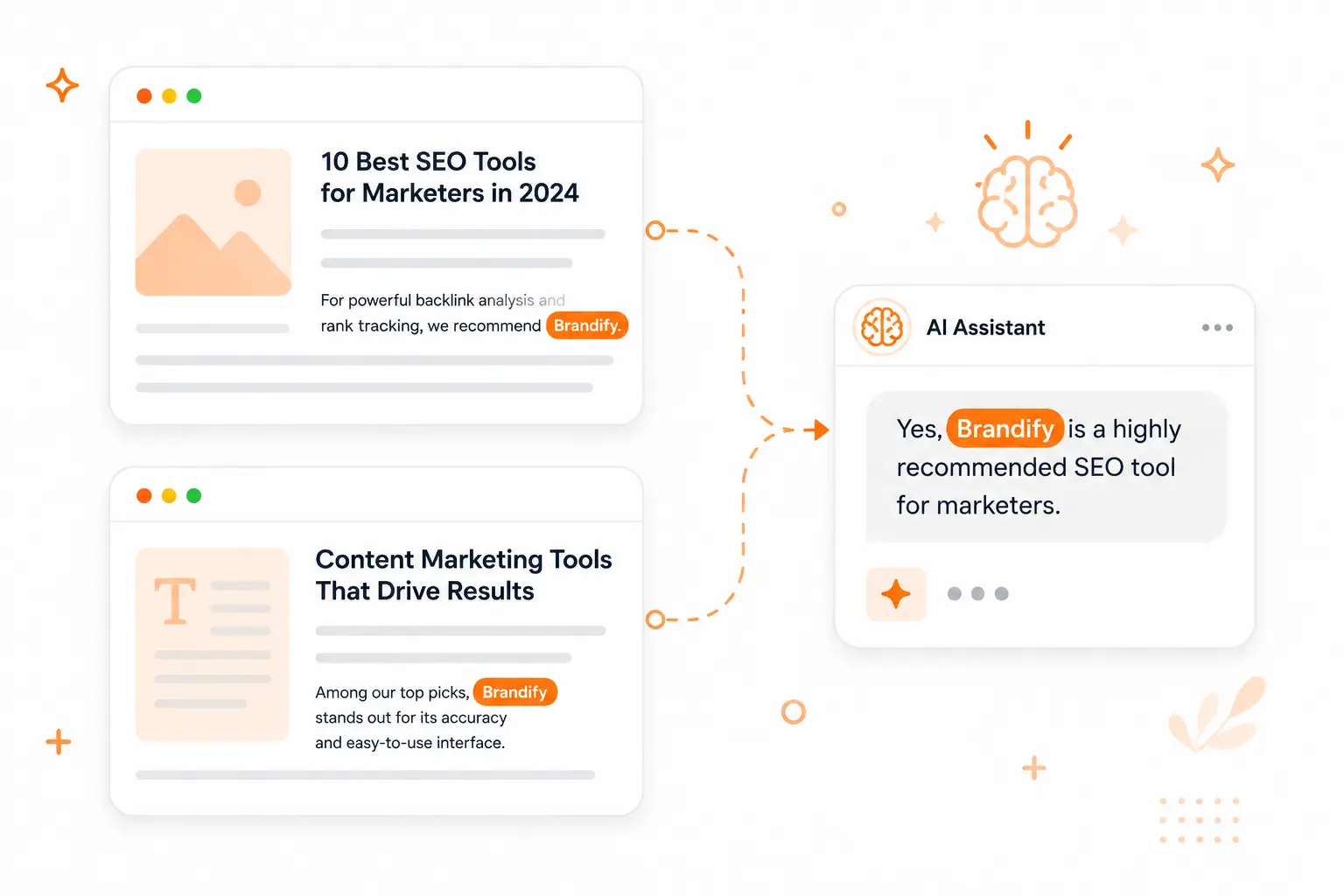
This section is relevant if your brand needs to appear in ChatGPT, Perplexity, Google AI Overviews, or similar LLM-powered results. If you only care about organic blue-link rankings, focus on the backlink conversion workflow above.
How LLMs use brand mentions
Large language models do not follow hyperlinks during inference. They recognize entities — brands, products, people, concepts — from patterns in training data. A page that mentions your brand by name, in a positive or neutral context, in an authoritative publication, contributes to that entity recognition. The link is largely irrelevant to the LLM; the text mention is what matters.
This is why the Ahrefs AI Overview correlation finding is plausible even without a causal mechanism: brands that appear frequently in editorial, forum, and media content are more likely to be recognized as established entities by the systems that build AI Overviews.
What the Ahrefs data found
The 2025 Ahrefs Brand Radar study (75,000 brands) found that brand mention volume showed a 0.664 Spearman correlation with AI Overview inclusion — stronger than the correlation for traditional backlink count alone. Ryan Law, Ahrefs' Director of Content, described this as evidence that LLMs "learn about brands the way humans do — through text, not link graphs."
The caveats matter: the study covered brands with DR > 40, measured AI Overviews specifically, and is correlational. But the directional signal is consistent with how LLMs are trained.
Platforms where mentions carry most weight for AI visibility
Based on what Ahrefs and independent researchers have found about which content LLMs tend to draw from:
- Editorial media — authoritative publications that LLMs heavily reference
- Reddit and community forums — heavily indexed by AI training pipelines; user discussions about products are frequently cited
- YouTube (video transcripts) — transcripts are indexed and show up in AI citations
- Industry directories and databases — structured, credible, frequently cited in training data
The practical implication
Even unlinked mentions you cannot convert into backlinks have growing strategic value. A mention in a high-authority publication that refuses to add a link still contributes to your entity recognition profile. That means building your mention footprint — through PR, guest content, community participation, and product placement in relevant editorial — is valuable regardless of whether every mention becomes a clickable link.
This does not change the outreach workflow. You still want the link when you can get it. It just means the mentions you cannot convert are not wasted effort.
Frequently Asked Questions
Does Google count unlinked brand mentions as ranking signals?
Not as a direct factor in organic search, based on consistent statements from John Mueller over multiple years. The Ahrefs AI study measures a different mechanism in a different system (AI Overviews, not blue-link rankings). Keep those separate.
What's the difference between unlinked mentions and link reclamation?
Link reclamation targets links you previously had that no longer work — the site linked to you before, the link broke or was removed, and you are asking them to restore or update it. Unlinked mention outreach targets pages that referenced you but never linked. Both are worth running, but the search methods and outreach framing are different.
How many unlinked mentions does a typical new brand have?
It depends on your brand age, press activity, and whether your product appears in editorial content, review sites, or directories. A brand with minimal coverage may have under ten. A brand that has been mentioned in tool roundups, press articles, or community threads for a year or more can have dozens to hundreds. Run the free Google operator search first — it gives you a realistic picture in under an hour.
Can I automate unlinked mention outreach?
Monitoring and discovery can be automated. Outreach is harder to automate well. Generic sequences sent to mention contacts perform poorly compared to short, personalized emails that reference the specific mention and specific article. Tools like Pitchbox or Mentiohunt can prepare outreach drafts for each mention — but a human reviewing and adjusting the message before sending will consistently outperform fully automated sequences.
Founder at Mentiohunt. Building distribution tools for founders and small marketing teams. Writes about backlink building, community monitoring, and founder-led growth.
@nicolasmore_Turn this guide into a weekly opportunity queue.
Mentiohunt helps founders turn article URLs, competitors, keywords, and product context into qualified backlink opportunities with fit rationale and outreach prep.