Prefer AI? Summarize this with ChatGPT,
Claude,
Google AI Overview, or
Perplexity.
Most guides on Pinterest backlinks start with the do-follow debate and leave you more confused than when you started. Here's the short version: most Pinterest links are nofollow, but that's the wrong frame. Pinterest is a visual search engine — and when you treat Pins like indexed web pages pointing back to your site, the strategy clicks.
Quick answer: Pinterest links are mostly
nofollow, but Pins and boards are indexed by Google and can rank independently in search results. The real play is referral traffic and brand discovery at volume. Set up a Business account, claim your website, publish 2–5 vertical Pin variations per landing page with keyword-rich descriptions, and stay consistent — Pinterest's algorithm heavily rewards regular publishing over one-time bursts.
What Pinterest backlinks actually are
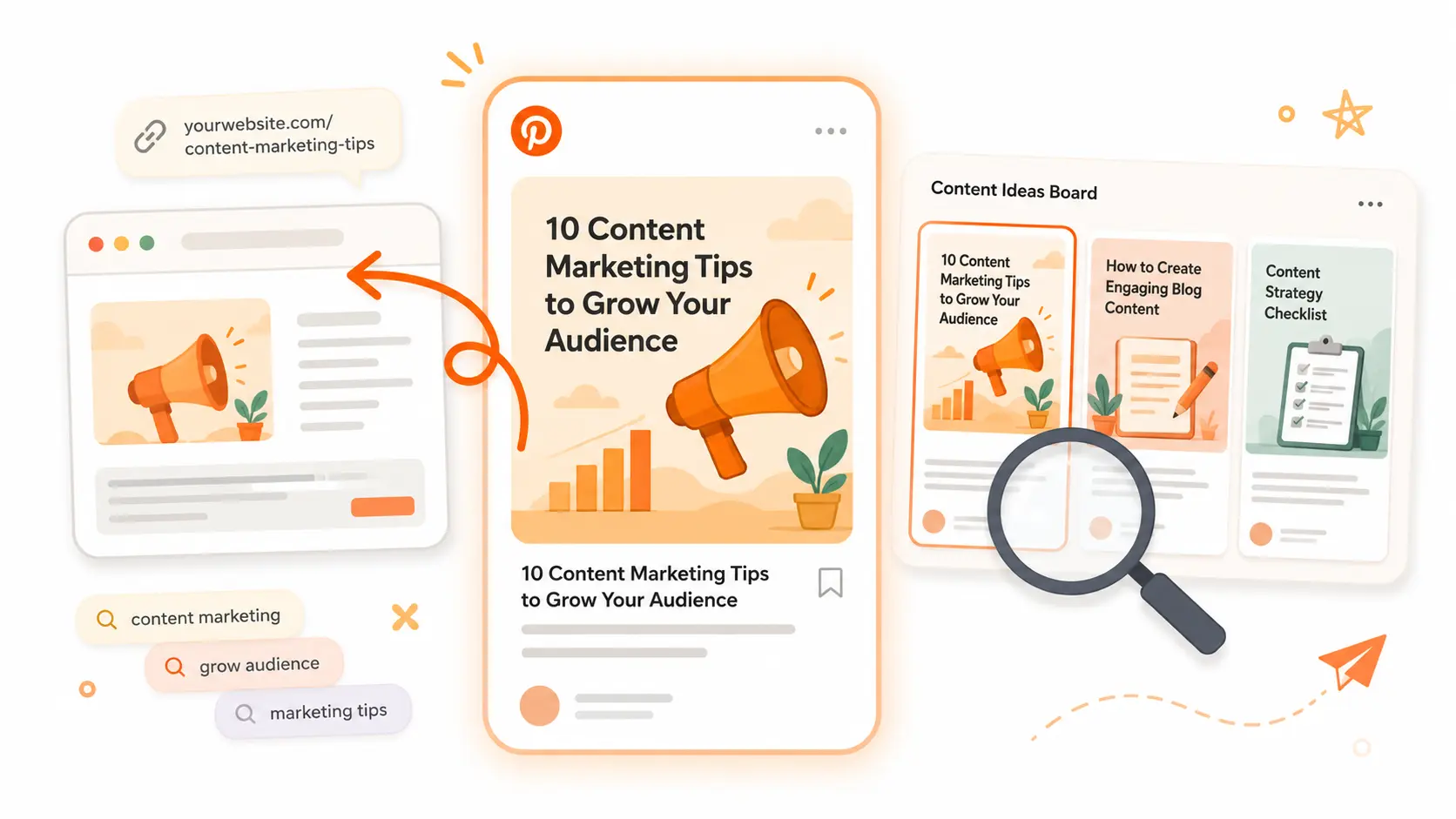
Every Pin you create contains a link to the source URL you set. Clicking the Pin takes users directly to your page — so each Pin is a functional backlink. Pinterest pages are crawled and indexed by Google, which means your Pins and boards can appear in search results and contribute to referral traffic independently of your own site.
The catch: most Pinterest links carry a nofollow attribute, so they don't pass PageRank the same way an editorial citation would. The exception is content featured on Pinterest's official Idea or Editor boards — those have been reported to carry do-follow links in some cases. Don't build your strategy around chasing that outcome. Build around referral traffic and brand signals first; the authority lift is a bonus.
If you're evaluating Pinterest alongside other platforms, this is a different play than getting backlinks from news websites or from Forbes — those channels have stronger direct link equity. Pinterest's value is volume, consistency, and discovery.
Set up the foundation
Before publishing a single Pin, two things need to be in place:
- Convert to a Pinterest Business account and claim your website. This ensures Pins display the correct source URL, unlocks Pinterest Analytics, and adds a verified badge to your profile. Without it, your link attribution is weaker.
- Make your landing pages mobile-ready. Pinterest traffic skews heavily mobile. A slow or cluttered page kills the click-to-conversion before it starts.
Build Pins that rank and get saved
Pinterest search works like a search engine. The algorithm reads Pin titles, descriptions, board names, and even the filename of the image you upload.
- Use vertical images at 2:3 ratio — they perform consistently better in feed and search.
- Add a readable text overlay with a clear CTA so the value is obvious before the click.
- Write keyword-rich Pin titles and descriptions. If the Pin is about a blog post on link-building tactics for SaaS founders, say that — don't write a vague caption.
- Rename your image file before uploading:
link-building-tactics-saas.jpginstead ofIMG_4821.jpg. Fill in the alt text field with a plain-language description. - Create 2–5 Pin variations per landing page — different thumbnails, text overlays, CTAs. Test what gets saved and clicked. The best performer will compound over time as Pinterest shows it to more people.
Boards strategy
Board organization is indexed by both Pinterest and Google. A board named "SaaS Link Building Tactics" will surface in different searches than one called "Marketing Tips" — even if you pin identical content to both.
Practical board rules:
- Name boards with specific keyword phrases, not broad categories. Think about what someone would type into Pinterest or Google to find your content.
- Write a board description of 150–200 words with natural keyword usage. This is often skipped and is consistently underrated as a ranking signal.
- Contribute to group boards in your niche. When your Pin gets saved from a group board, Pinterest interprets it as a topical relevance signal across a wider audience — useful for new accounts with small followings.
- Organize by content type and topic, not by publish date or campaign. A board that mixes blog posts, tools, and stat pages sends weaker signals than three separate boards, each tightly themed.
The board-level organization is what lets Pinterest treat your profile as a topical authority, not just a posting account.
Amplify reach and earn link authority
Consistent publishing is table stakes. The algorithm favors accounts with regular fresh Pins — daily if you can manage it. A scheduling tool like Tailwind makes this sustainable without spending an hour a day on it.
Beyond volume, the highest-leverage move is getting Pins saved onto large, relevant boards run by other people. Find niche board owners in your category and pitch inclusion. If your Pin gets featured on Pinterest's Editor or Idea boards, you've hit the best realistic shot at a do-follow link — but these come from producing genuinely useful content, not from direct outreach to Pinterest.
One often-missed signal: Pinterest tracks how long visitors stay on your site after clicking. High dwell time tells Pinterest your Pins deliver on their promise, which increases distribution. Make sure the landing page matches what the Pin promises — the same principle that makes Reddit backlink outreach work: fit over volume.
What this looks like in practice
Take a specific, useful page — say, a deliverability checklist for cold outreach senders. Pin three variations against it: one framed as a checklist graphic, one as a "before/after inbox placement" comparison, one as a plain text-overlay quote pulled from the guide. Each gets a keyword-rich description naming the exact problem it solves (domain warm-up, SPF/DKIM setup) rather than a generic caption.
The pattern that shows up consistently across accounts doing this correctly: the checklist-style variation outperforms the other two on saves within the first two weeks, because it reads as immediately useful without clicking through. Outbound clicks lag saves by roughly that same two-week window — Pinterest needs to see engagement on a Pin before it distributes it more broadly. This is why judging a Pin's performance after three or four days produces the wrong conclusion. The saves-to-clicks gap is the timeline working as intended, not a sign the Pin failed.
None of this replaces a real editorial backlink. It is a parallel channel: a nofollow Pin that sends 40 engaged visitors a month to a guide is doing a different job than a dofollow link from a relevant blog, and the two are worth pursuing at the same time rather than instead of each other.
A week-one routine
| Day | Action |
|---|---|
| Day 0 | Set up Business account, claim your website, pick 3–5 landing pages to promote |
| Days 1–7 | Create 3 Pin variations per page, write keyword-rich descriptions, schedule across the week |
| Ongoing | Check analytics weekly, reshare top performers to new boards, pitch niche board owners for inclusion |
Reading your analytics
Pinterest Analytics prioritizes metrics in this order for referral traffic goals: outbound clicks > saves > impressions. Impressions tell you reach; saves tell you resonance; outbound clicks tell you actual traffic value.
What to watch:
- Outbound click rate by Pin. This is your primary signal. A Pin with high saves but low clicks is resonating visually but not converting — adjust the CTA or the landing page promise.
- Top boards by traffic. If one board consistently drives clicks, create more Pins for it and tighten the topical focus.
- Monthly unique viewers. A vanity metric. Don't optimize for it directly; it rises naturally as click rate improves.
Check analytics weekly for the first month, then monthly once patterns are stable. The best-performing Pin format from the first 30 days is what you should replicate — Pinterest rewards consistency in creative format as much as posting frequency.
What to avoid
- Chasing do-follow links as a primary goal. The vast majority of Pinterest links won't be do-follow regardless of what you try. The time spent chasing them comes at the cost of producing content worth pinning and distributing.
- Pinning your homepage. Homepages don't match the specific intent of Pinterest search queries. Send traffic to specific pages — a guide, a free tool, a data post — where the Pin description and landing page are topically aligned.
- Posting once and stopping. Pinterest's algorithm weights recency and consistency heavily. A burst of Pins followed by silence signals an inactive account, reducing distribution for all your existing Pins over time — not just new ones.
- Ignoring image filenames and alt text. Pinterest reads the filename of uploaded images and the alt text field.
IMG_4821.jpgcontributes nothing.saas-link-building-guide-2026.jpgadds a keyword signal before the Pin is even published.
The bottom line
Pinterest works as a brand signal engine and referral traffic channel, not a direct link equity source. It pairs well with community-driven plays like Quora, where you're also building discovery across indexed platforms rather than earning one-time editorial placements.
Once your content earns Pinterest traffic, the next step is finding which sites are already linking in your space. Mentiohunt's backlink building engine takes your article URLs, surfaces relevant sites where your content fits, and prepares and schedules outreach automatically — so the prospecting work is already done when the sequence starts.
This guide was written by the Mentiohunt team. We build tools for founders doing their own link building and community outreach.

Founder of Mentiohunt. Built the company's own backlink pipeline using the same methods covered here — expert quote outreach, journalist sourcing platforms, and citation-worthy assets. Writes about link prospecting and founder-led distribution.
@nicolasmore_Turn platform research into a recurring opportunity queue.
Mentiohunt helps founders turn article URLs, competitors, keywords, and product context into qualified backlink opportunities with fit rationale and outreach prep.