Prefer AI? Summarize this with ChatGPT,
Claude,
Google AI Overview, or
Perplexity.
Most guest post campaigns fail at the list, not the email.
The founder spends two hours writing a tight, personalized pitch. It gets deleted in four seconds because the site has no real readers, the editor has seen 40 identical requests this week, or the "editorial blog" is quietly selling placements for $150 a post. The email was fine. The target was the problem.
Cold outreach to unqualified lists converts at roughly 3–5%. Outreach to well-qualified targets — sites with real traffic, genuine editorial standards, and topical relevance to your content — converts at 25–40%. That gap is entirely in the list.
This guide covers a four-step prospecting system built for founders running guest posting themselves. The goal is a prioritized, outreach-ready list from any niche — not a sprawling spreadsheet that never gets worked.
Step 1: Know What Makes a Site Worth Pitching
Before sourcing a single prospect, define your qualification criteria. Without them, you end up with 200 domains and 150 of them should never have made the list.
Four signals matter:
- Topical fit. The site covers content where your article or product belongs in context. Not "adjacent" or "broadly B2B" — actually in your topic area. A link from a site your target audience reads regularly is worth more than ten links from generalist blogs.
- Organic traffic, not just DR. Domain Rating measures backlink volume, not site health. A site can have DR 55 and nearly zero organic traffic because it bought links years ago and coasted. Check estimated organic traffic in Ahrefs or Semrush. A site with DR 30 and 8,000 monthly visitors in your niche is a better target than one with DR 60 and 500.
- Active editorial calendar. Look at the blog. When was the last post published? If it is from 2024, the editorial contact may no longer be active and any link you earn may sit on a site gradually losing search trust. Look for consistent publishing within the last 60–90 days.
- Evidence of real contributors. Check the About or Contributors page. Are there named authors with LinkedIn profiles, subject-matter credentials, or recognizable profiles in the industry? A contributor list with 30 authors from completely unrelated industries signals the site takes paid placements indiscriminately. A list of 6–8 focused practitioners is a far better signal.
| Signal | Minimum threshold | Instant disqualify |
|---|---|---|
| Domain Rating | DR 25+ | DR 70+ with under 1,000 traffic |
| Organic traffic | 2,000+ monthly | No traffic data or declining 6 months straight |
| Last published | Within 90 days | Nothing new in 6+ months |
| Topic fit | Core topic overlap | Generalist content across 10+ unrelated niches |
| Contributors | Named authors with credentials | Anonymous content or 20+ mixed niches represented |
Set these thresholds before you source anything. They do not need to be perfect — they need to be consistent enough to prevent junk from entering the list.
Step 2: Build Your Initial Prospect List
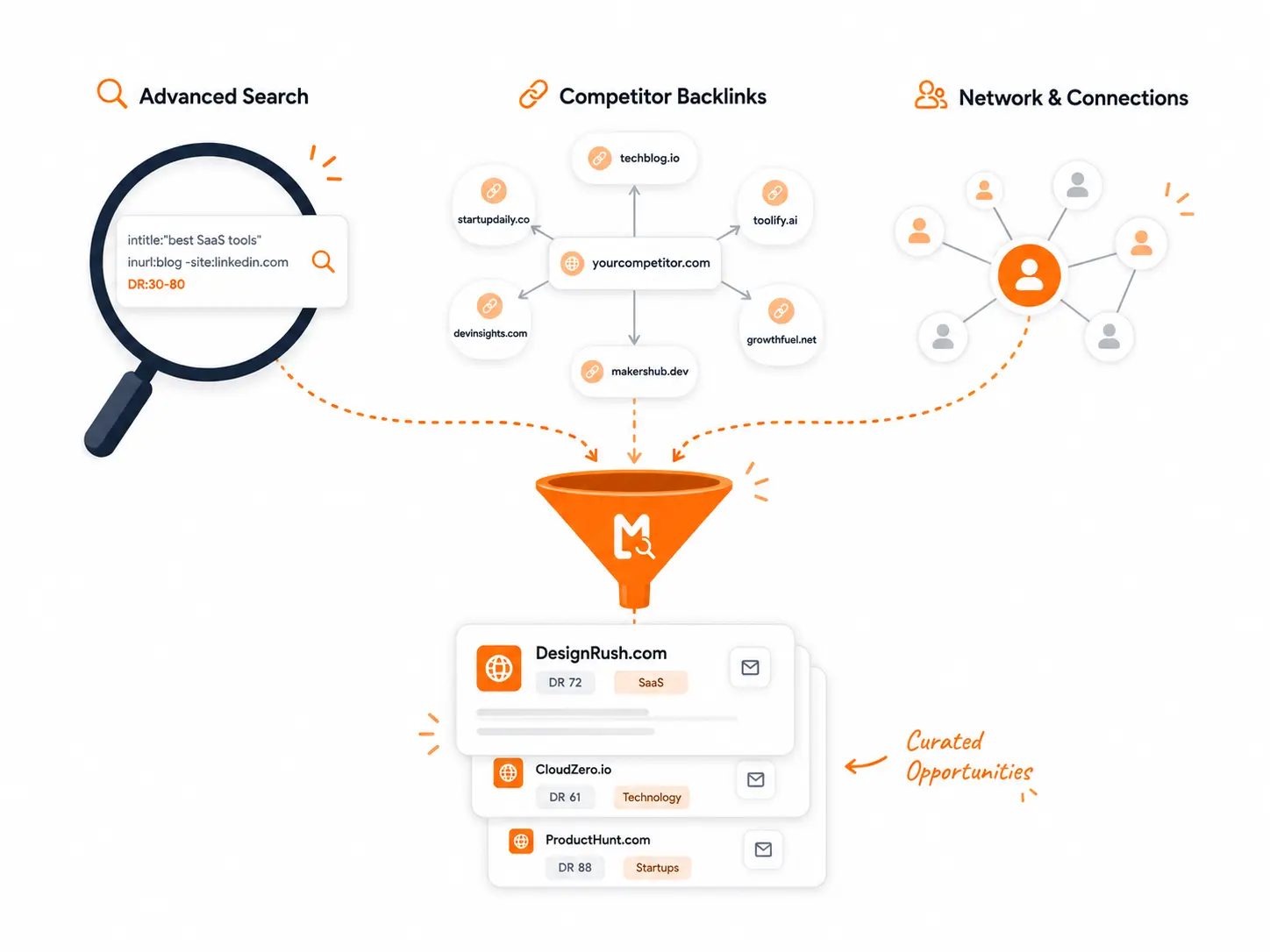
Three methods are worth running. Each has a different profile of speed, result quality, and cost. Start with one and add a second once you have worked the first list. These same channels apply across tactics, not just guest posts — see how to find backlink opportunities for the full discovery workflow.
Google Search Operators
Free, fast to start, and good for finding sites your competitors have not tapped yet. The limitation is that "write for us" searches are saturated — the same results appear for everyone running the same query, which means those targets receive high outreach volume and low conversion rates.
The more effective approach is content-pattern searches: finding sites that already publish the type of content where you would fit as a contributor, without relying on explicit guest post pages.
If you'd rather not build and run these queries by hand, the Guest Post Sites Finder automates this exact workflow — paste your website URL and it detects your niche, runs the footprint searches below for you, and scores each result for fit.
intitle:"write for us" [your topic]
inurl:contribute [your topic]
"[your topic]" "guest post guidelines"
"[your topic]" "become a contributor"
"[your topic]" "submit a guest post"
intitle:resources "best [tool category]" inurl:blog
Go further with content-pattern searches that find real editorial sites:
intitle:"[specific topic your article covers]" -site:yourcompetitor.com
"[keyword your audience searches]" inurl:blog
"for SaaS founders" OR "for B2B founders" inurl:blog [your topic]
"tools for [your category]" site:*.com/blog
These find sites that already publish the kind of content you would contribute — without requiring them to have a visible guest post policy. Many editorial sites accept pitches but never advertise it.
Competitor Backlink Analysis
The most efficient prospecting method if you have Ahrefs or Semrush. Sites that linked to your competitors editorially have already proven they publish your content type and accept external contributions. You are not guessing — you are finding sites with a track record.
Workflow in Ahrefs:
- Run Link Intersect against 2–3 competitors. Look for sites linking to multiple competitors but not to you.
- Filter referring domains: DR 25–70, organic traffic above 2,000, dofollow links only.
- Exclude homepage links — those tend to be brand mentions, not editorial placements.
- Open each URL and check the context: was it a guest post, a curated roundup, or a product mention? Guest posts and roundups are actionable; raw product mentions need a different pitch type.
Both methods belong in a mature prospecting workflow. Operators surface sites your competitors have not found. Competitor backlinks surface sites with proven editorial willingness to link in your space.
Community and Network Discovery
Relationship-based outreach converts 5–8× better than cold outreach. The reason is simple: the editor already has some context on you before you pitch. Even a lightweight prior connection changes the dynamic.
Practical ways to build this list without spending weeks networking:
- LinkedIn: Search for "[topic] blog" or "[niche] content" filtered to your connections. First-degree connections who run blogs you could contribute to are the highest-conversion targets you have.
- Niche Slack groups and communities: Editors in focused communities often announce when they need contributors or are looking for specific expertise. Being present in 2–3 active communities in your category pays off over time.
- People who engage with your content: Readers who comment on your articles, share your posts, or reply to your newsletters and also run their own publications are warm targets. They already know your thinking.
- Tool directories in your category: Many publish editorial content and accept guest contributors, especially for practitioner pieces with real depth.
This method builds more slowly than the other two, but the resulting list has a fundamentally higher conversion rate because it contains people who already know who you are.
Step 3: Vet Before You Pitch
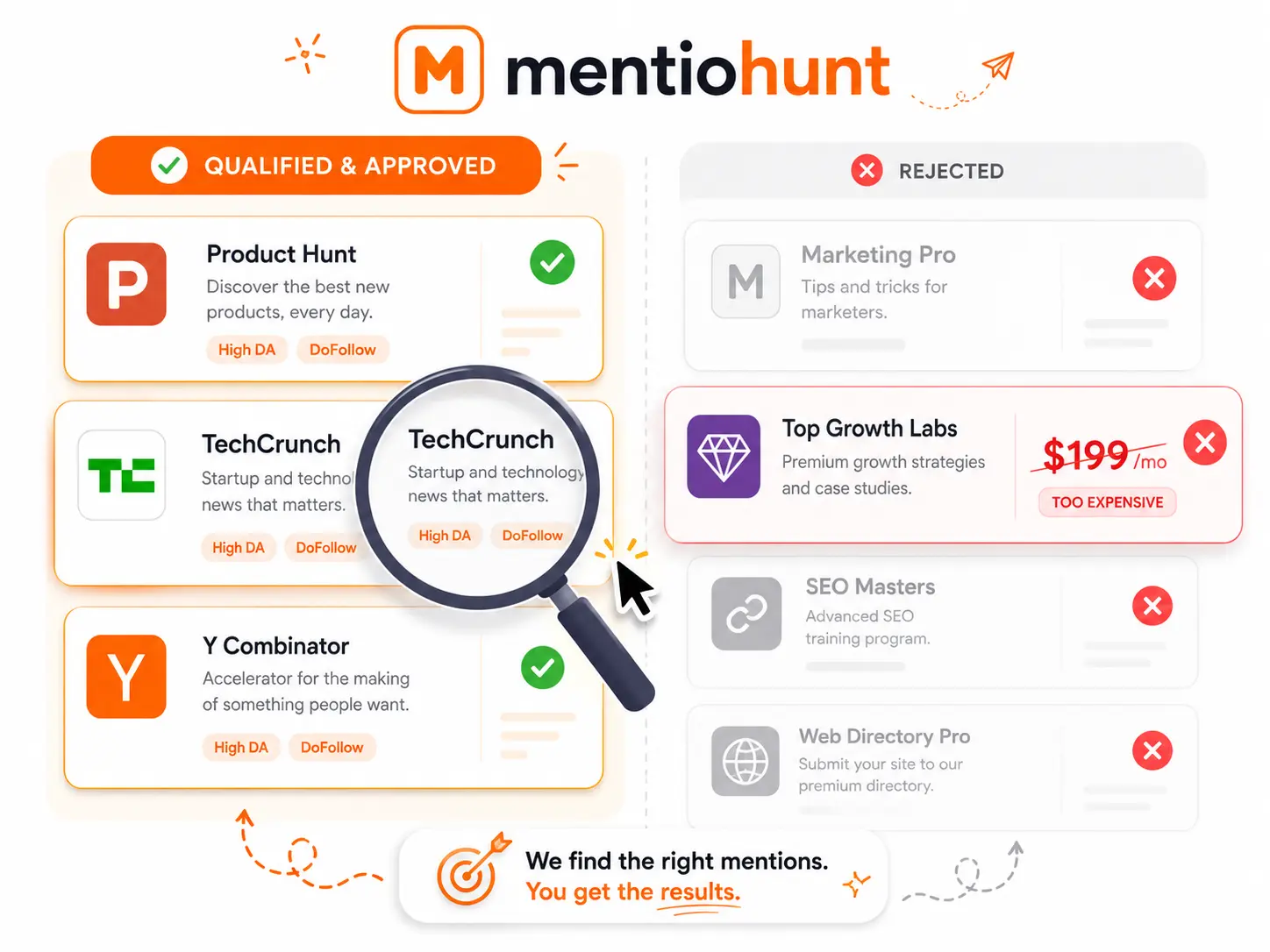
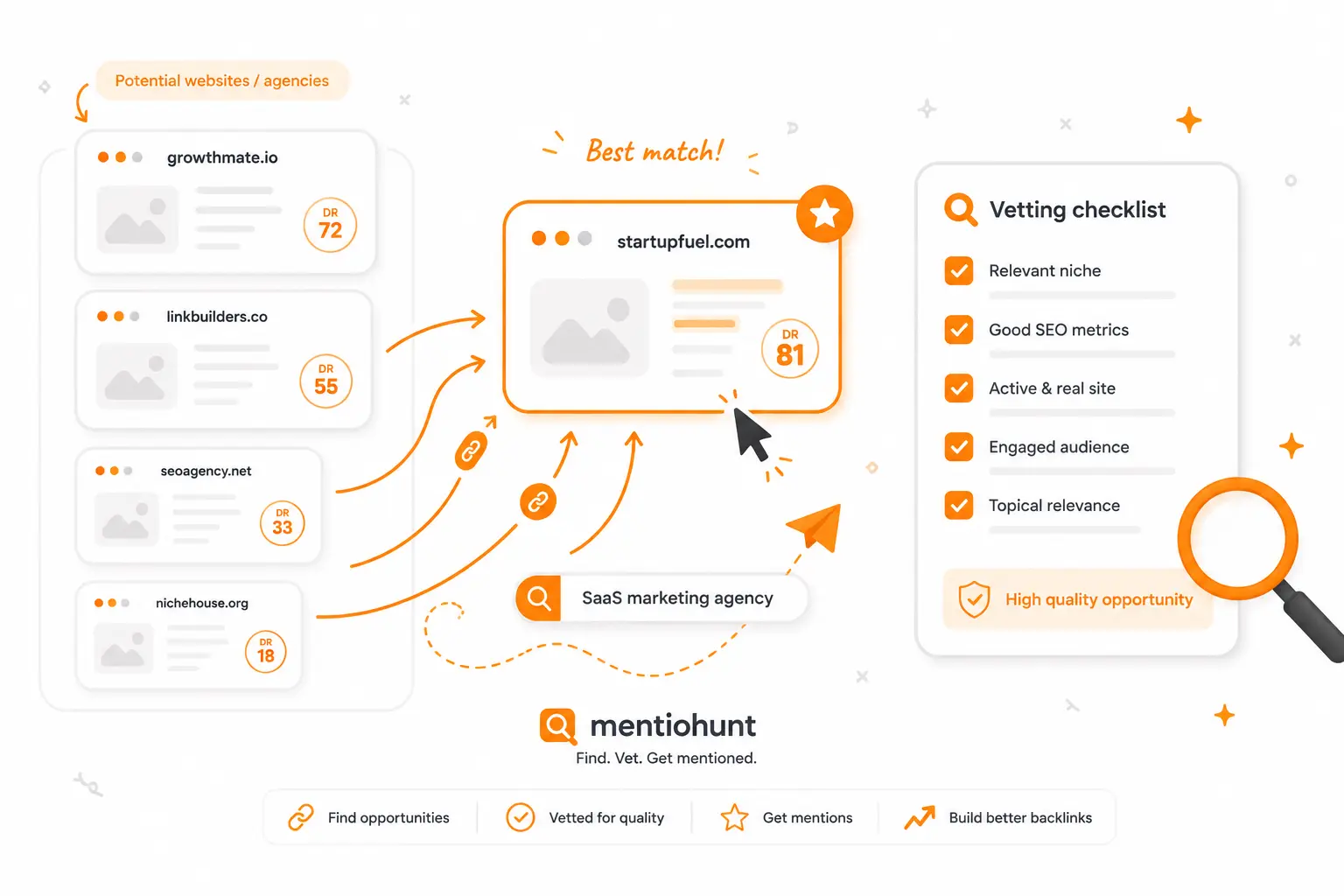
Sourcing gives you a long list. Vetting gives you an actionable one. The 5-minute site check below runs before any prospect enters your outreach tracker.
| Check | What to look for | Pass or skip |
|---|---|---|
| Homepage → Blog | Recent posts, consistent topic focus, real author names | Pass if active within 60 days |
| About / Contributors | Named authors, credentials, focused subject area | Pass if specific — skip if 20+ mixed niches |
| One recent post | Actual content quality vs. thin affiliate or AI output | Pass if you would read it yourself |
site:[domain] "sponsored" OR "advertorial" | Proportion of paid content | Skip if more than 20% carry a paid label |
| Ahrefs or Semrush organic traffic | 6-month trend | Skip if declining sharply or near-zero |
Spotting Pay-to-Play Sites Early
Around 45% of sites that appear to accept guest posts actually require payment. Identifying these before you pitch saves hours.
Red flags to disqualify on:
- Your initial inquiry gets a pricing sheet in response ("guest post placement starts at $X")
- The site has an "Advertise" or "Sponsored Content" page with published rates visible to anyone
- Contributor list spans dozens of authors from completely unrelated industries — fintech, fitness, home improvement, SaaS all in one place
- DR is high but organic traffic is very low — a sign the domain runs link placements as a business, not as an editorial blog
- The site's domain name contains terms like "guest posts," "link placement," or "sponsored content"
If any of these appear, disqualify without sending a pitch. These sites produce links that Google's 2025 spam guidance explicitly targets. The June 2025 Core Update focused on large-scale guest posting networks and sites primarily existing to sell link placements. A link from one of these sites is not just low-value — it can become a liability.
What Google's Spam Policy Means in Practice
Google explicitly flags "large-scale article campaigns with keyword-rich anchor text links" as a link scheme. For founders:
- Use natural anchor text, not exact-match keyword phrases in every placement
- Avoid contributing to sites that publish across a dozen unrelated niches or that clearly exist to monetize link placements
- Prioritize sites where your contribution genuinely adds to their editorial mix, not sites where your piece will sit between a cryptocurrency roundup and a home renovation guide
The sites that still produce real SEO value in 2026 are the ones that were always worth targeting — real readership, real editorial standards, real topical authority. The filtering work you do in vetting is what separates a link profile that compounds from one that eventually gets discounted.
Step 4: Organize the Pipeline
A prospect list without a tracking system is a spreadsheet you abandon after week two.
Minimum fields for a functional tracker:
| Field | Purpose |
|---|---|
| Domain | Target URL |
| DR | From Ahrefs or Semrush |
| Monthly traffic (est.) | Quick quality check |
| Topic fit score | 1–3, where 1 = weak and 3 = strong overlap |
| Contact name + email | Who to reach |
| Source | Operators / competitor backlinks / network |
| Status | Not contacted / Sent / Replied / Placed / Rejected |
| Notes | Previous reply, connection type, pitch angle |
| Date last updated | Pipeline hygiene |
Spreadsheet vs. CRM: At 30–50 pitches per month, a Google Sheet works fine. The friction of configuring a CRM outweighs the benefit until you are managing 100+ active contacts simultaneously or running campaigns across multiple programs.
Volume math to hit 2–3 placements per month:
- Source 40–60 prospects from your chosen methods
- Qualify down to 15–20 that pass the vetting criteria above
- Pitch 10–15 of the strongest
- Expect 1–3 replies and 1–2 live placements from cold outreach
These numbers assume reasonable targeting and personalized pitches. If you have any relationship warmth with targets on the list — they follow you, they know your product, you have a shared connection — the conversion rate on that subset improves significantly. This is why building a small network discovery pipeline in parallel with cold sourcing is worth the slower ramp time.
For outreach reply-rate benchmarks pulled from real campaigns instead of third-party surveys, see Mentiohunt's link building outreach statistics.
Weekly cadence: Block two hours per week for sourcing and vetting and a separate two to three hours for writing and sending pitches. Running both in the same session leads to skipping vetting under time pressure — which degrades the list faster than anything else.
What to Automate and What to Keep Manual
Prospecting has clear stages where automation helps and clear stages where it does not.
- Automate: Initial site discovery through search operators, deduplication across past campaign lists, basic traffic pulls, and contact email finding through tools like Hunter.io or Apollo.
- Keep manual: Qualification judgment — no tool reliably distinguishes real editorial quality from pay-to-play at the nuance required. Pitch personalization — the specific observation that proves you read the target piece cannot be generated without actually reading it. Follow-up timing — context matters, and a rule-based sequence applied uniformly misses signals a human follow-up would catch.
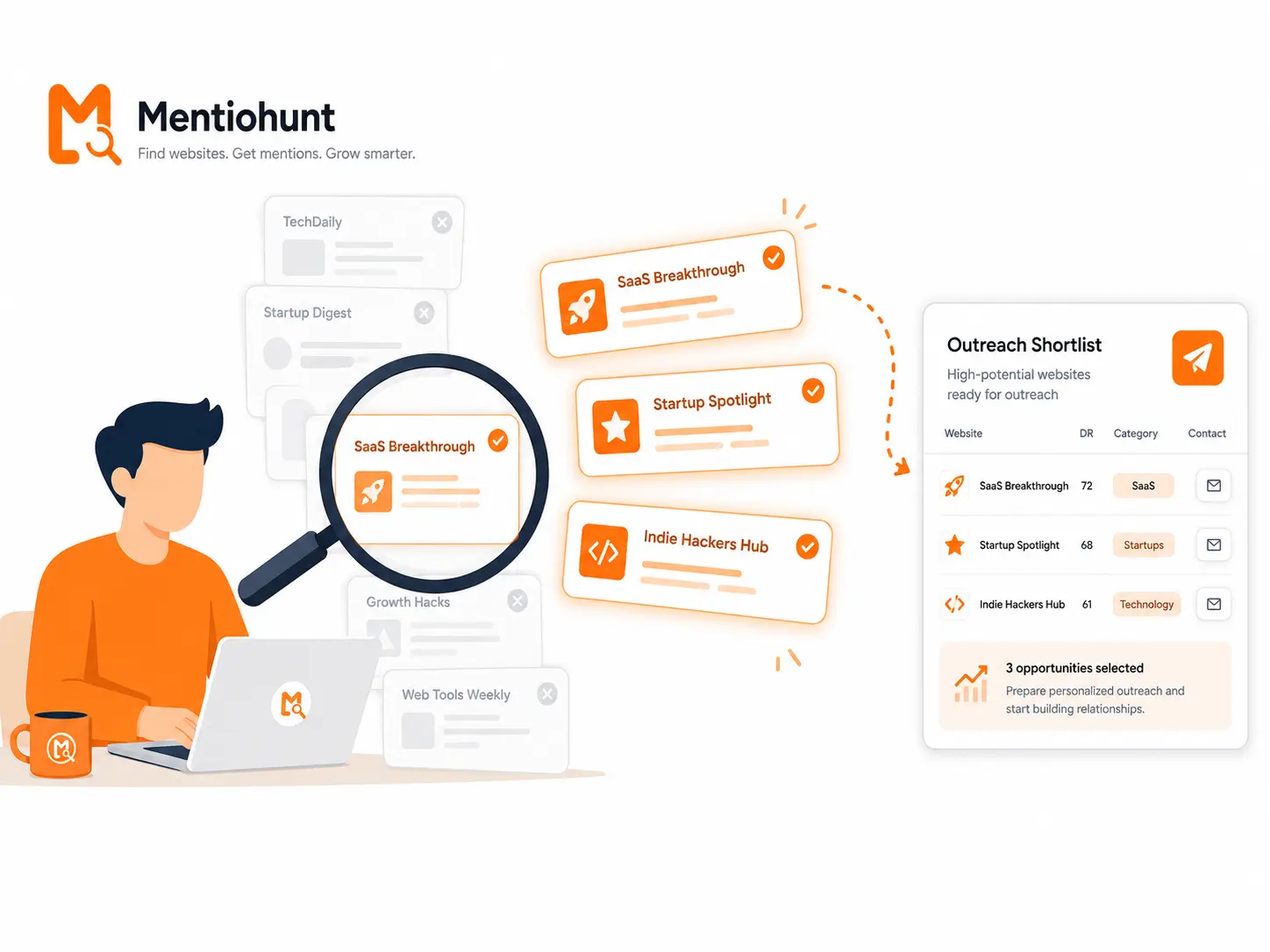
If you want to skip the initial sourcing and discovery work, Mentiohunt surfaces qualified prospects from your existing article URLs — it finds sites where each piece fits editorially, scores topical relevance, and prepares a contact and outreach angle per opportunity. The manual judgment starts at the pitch, not the list.
Guest posting compounds slowly. One or two placements per month adds up to a meaningful backlink profile over 12 months without dominating your calendar. The founders who get the most out of it are the ones who run a consistent, narrow process — not the ones who do a burst campaign and stop.
For the outreach side — how to write the pitch, structure a follow-up sequence, and handle deliverability before your first send — the link building outreach email guide covers the execution layer in detail.
Frequently Asked Questions
What DR should a guest post site have?
DR (Domain Rating) is a secondary signal, not a primary filter. A site with DR 30 and 5,000 monthly organic visitors in your niche is worth more than a DR 70 site with near-zero traffic. Use DR 25+ as a minimum floor, but always verify organic traffic independently — high DR with no traffic is a common sign of a link-selling site or a domain coasting on historical links.
How many prospects do I need to source per placement?
A realistic rule for founder-run outreach: source 30–50 prospects to pitch 10, and expect 1–3 placements. Cold outreach to unqualified lists converts at roughly 3–5%. Relationship-based or well-qualified outreach can reach 25–40%. The gap is almost entirely in list quality, not email copy.
How do I spot a paid-placement site before outreach?
Four signals: the site has a "sponsored post" or "advertise" menu item with published rates; the contributor list is unusually broad with no topic consistency; your first inquiry gets a pricing sheet instead of an editorial response; the site's backlink profile shows a spike of links from unrelated domains. If you see any of these, disqualify before spending time on a pitch.
Is guest posting still effective in 2026?
Yes, but the gap between good and bad guest posting has widened. Placements on sites with genuine traffic and real editorial standards still produce measurable SEO impact. The sites that no longer produce value are the ones that were always selling links — they just got easier to identify. Selective targeting on topically relevant, traffic-holding sites remains one of the more reliable link-building channels for SaaS founders.

Founder at Mentiohunt. Building distribution tools for founders and small marketing teams. Writes about backlink building and founder-led growth.
@nicolasmore_Turn this guide into a weekly opportunity queue.
Mentiohunt helps founders turn article URLs, competitors, keywords, and product context into qualified backlink opportunities with fit rationale and outreach prep.