Prefer AI? Summarize this with ChatGPT,
Claude,
Google AI Overview, or
Perplexity.
HARO link building means responding to journalist requests with useful, experience-backed commentary. If a journalist uses your contribution, the finished article may mention your company and link to your website.
The tactic still exists in 2026, but the product names are easy to confuse. HARO, Connectively, and Featured are now separate services owned by the same company. Qwoted, SourceBottle, and other alternatives run their own journalist-source marketplaces.
This guide explains the current landscape and gives you a workflow for choosing queries, writing useful pitches, and verifying the result.
What HARO link building is
Journalists and editors often need a practitioner, founder, or subject-matter expert to strengthen a story. A journalist-query service distributes those requests to potential sources. You respond only when your expertise matches.
If your response is selected, the journalist may:
- quote you by name;
- mention your company and role;
- ask a follow-up question;
- link to your site or profile.
The backlink is not guaranteed. The editorial mention is the primary outcome, and the publication decides whether and how to link. This is different from guest posting: you contribute a small piece of an article rather than writing the full article yourself.
HARO, Featured, and Connectively in 2026
The short history matters because many older guides now mix the three products together.
- Cision retired Connectively, the product that had replaced the original HARO, in December 2024.
- Featured acquired and revived HARO in April 2025.
- The revived HARO is a free, email-based service with three weekday editions.
- Featured relaunched Connectively as a separate web platform in May 2026.
- Featured is another separate product: an AI-assisted PR platform from the same company.
Featured documents the ownership and current product distinctions in its official company overview. In practical terms, signing up for one does not mean you are using all three.
HARO alternatives worth evaluating
| Platform | Format | Free access | Best fit |
|---|---|---|---|
| HARO | Three weekday request emails | Free | Sources who prefer scanning scheduled email digests |
| Connectively | Web-based journalist-source marketplace | Free and paid plans | Sources who want to browse and manage opportunities in a platform |
| Featured | AI-assisted PR workflow | Free and paid plans | Teams that want software support for finding and drafting responses |
| Qwoted | Web-based expert and media network | Basic plan includes two pitches per month | Sources targeting media requests with a structured profile and pitch workflow |
| SourceBottle | Email alerts and online callouts | Free access available | Sources looking for callouts across multiple regions and categories |
| Source of Sources | Curated email request list | Check current access terms | People who prefer a newsletter-style alternative from HARO's original founder |
Check each provider's site before committing time or budget. Limits and plan features can change. Qwoted, for example, publishes its current allowances on its pricing page.
For a B2B SaaS founder, the “best” platform is the one that repeatedly produces requests you can answer from direct experience. Try one or two sources, label every request by relevance, and compare qualified opportunities rather than total email volume.
Set up an expert profile journalists can evaluate
A clear profile helps an editor understand why your answer is credible.
Include:
- A specific role: “Founder of a B2B SaaS link-building platform” is more useful than “entrepreneur.”
- Narrow expertise areas: choose topics you work with regularly and can support with examples.
- A short bio: explain the experience relevant to those topics, not your full company history.
- A stable website URL: use a page that confirms who you are and what you do.
- A usable headshot: some publications ask for one alongside the quote.
Do not stretch your credentials to match more requests. A credible answer in a narrow field is more useful than a generic opinion across ten unrelated categories.
Choose queries before writing pitches
Use a simple qualification test:
- Can you answer from direct experience? You should have a real example, decision, result, or observation.
- Does your expertise match the stated requirements? Respect location, role, company size, and industry filters.
- Can you answer the exact question? Do not use the request as an excuse to pitch your product.
- Is the deadline realistic? A rushed, unsupported response helps no one.
- Would the association make sense to a reader? A relevant mention is more valuable than an unrelated high-authority placement.
Skip a query if you need to invent the evidence. Relevance is the first quality filter.
Write a pitch an editor can use
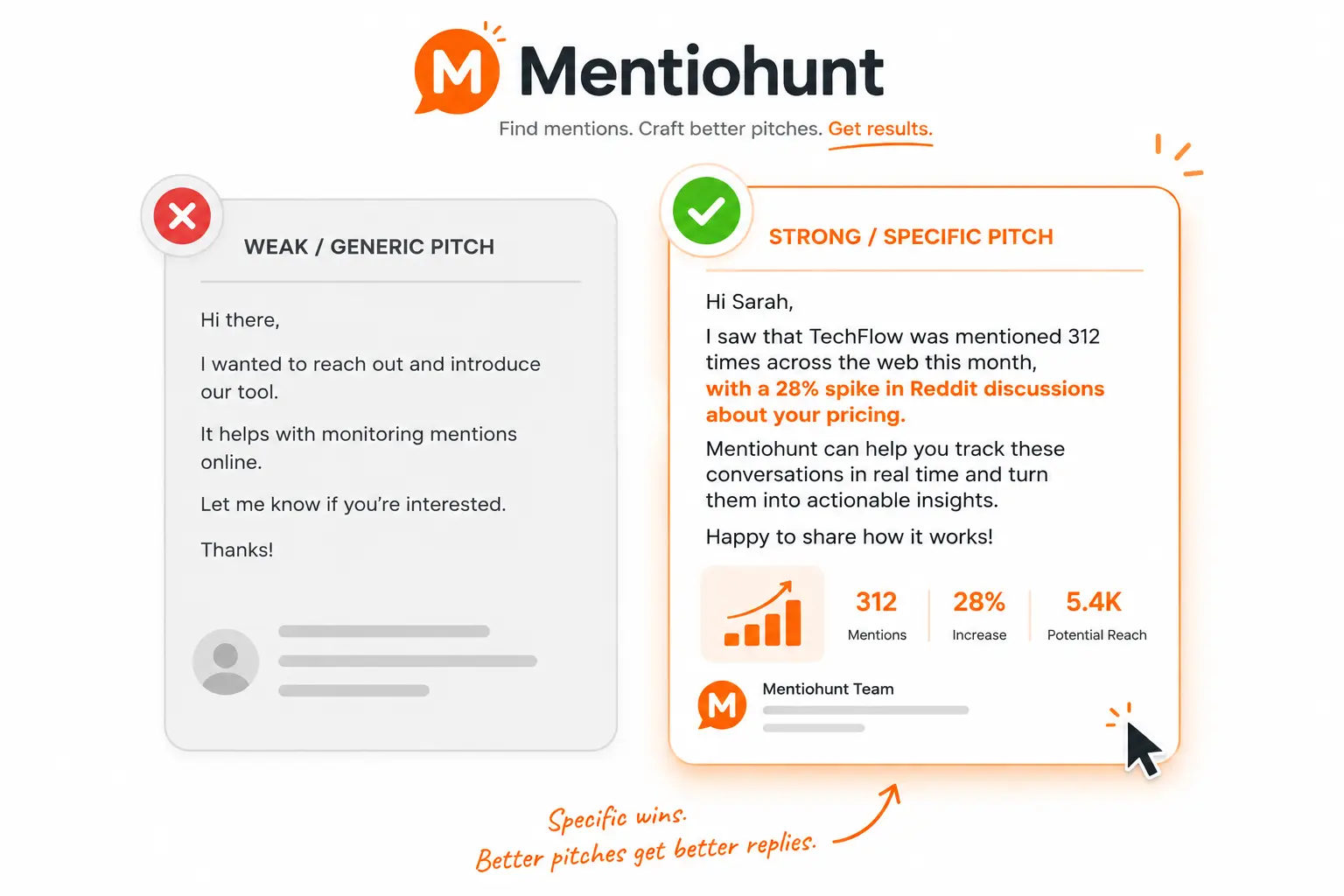
A useful response is short enough to scan and complete enough to quote. A reliable structure is:
- Credential: one sentence explaining why you have first-hand knowledge.
- Direct answer: respond to the question immediately.
- Proof: add a concrete example, observation, or result.
- Attribution: provide your name, role, company, and requested link.
Hi [Name],
I lead pricing experiments at [Company], a B2B SaaS product serving [audience].
The most useful change in our last test was removing one tier rather than adding another. Buyers compared the remaining options faster, and our sales team spent fewer calls explaining marginal feature differences. The lesson was to test decision clarity, not only price points.
You can attribute this to [Name], [Role] at [Company]. Bio and website: [URL].
Best, [Name]
This works because the journalist can evaluate the credential, identify the answer, and lift a self-contained observation without rewriting a company pitch.
What to avoid
- opening with several paragraphs about your product;
- responding outside your expertise;
- making numerical claims you cannot document;
- sending an answer that could apply to any company;
- asking the journalist to invent a quote from a vague offer to help;
- using AI-generated filler in place of a real example.
AI can help shorten or organize your writing. It cannot supply the experience that makes the response worth publishing.
Follow up without creating noise
Read the request carefully. If it says not to follow up, do not follow up. Otherwise, one concise message before the deadline can be reasonable when you are adding missing information or answering a new question.
After a response is selected:
- reply promptly to clarification requests;
- confirm spelling, title, and company name;
- provide supporting material only when asked;
- do not pressure the journalist to add a particular anchor text or link attribute.
The editor controls the final article.
Verify and measure placements
When an article goes live, record what was actually published rather than what you expected:
- publication and article URL;
- your quoted name and company attribution;
- destination URL, if linked;
- link attribute, such as nofollow or sponsored;
- referral visits and relevant conversions;
- the query topic and pitch angle that led to the placement.
A mention may appear without a link, and a link may be changed later. Check manually before counting it as a backlink. Avoid treating domain-rating metrics as proof of editorial value; topical relevance, readership, and the context of the citation matter too.
Ranking changes are also difficult to attribute to one placement. Review a sustained campaign over months alongside other SEO work, not a single link over a few days.
How HARO outreach fits with other link-building channels
Journalist queries are reactive: someone publishes a request and you decide whether to respond. They work best alongside channels you can initiate yourself.
For example:
- reclaim unlinked brand mentions;
- suggest your original data or tool for relevant resource pages;
- offer a useful addition to an article that already covers your topic;
- pursue guest contributions where you have a genuinely distinct point of view.
Mentiohunt handles that proactive side. You provide your website, product, competitors, keywords, and priority pages; it discovers fitting opportunities and runs personalized outreach through the first reply. You can monitor the queue and cancel opportunities that are not a fit while continuing to answer journalist requests yourself.
Frequently asked questions
Is HARO still free in 2026?
Yes. HARO is a free standalone email service owned by Featured. It sends journalist requests in three weekday email editions. Featured and Connectively are separate products from the same company and offer their own free and paid plans.
What is the difference between HARO and Connectively?
HARO is the familiar email-based journalist request service. Connectively is a separate web platform where sources can browse and respond to opportunities. Featured owns both products.
Is Qwoted free?
Qwoted has a Basic plan with two pitches per month. Its paid plans increase pitch allowances and add workflow features. Check Qwoted's current pricing page before choosing a plan.
How many journalist queries should I respond to?
Only respond when your direct experience fits the request. A few relevant, evidence-backed pitches are more useful than a high volume of generic responses. Track submissions and placements so you can improve your selection criteria over time.
Can I use AI to write HARO pitches?
AI can help organize a draft, but the evidence must come from you. Replace generic language with a specific observation, result, example, or lesson from direct experience, and verify every claim before sending.
Does every journalist placement include a dofollow backlink?
No. A journalist may quote you without linking, link with a qualified attribute, or change the link later. Treat editorial coverage as valuable, but verify each published placement before recording it as a backlink.

Founder at Mentiohunt. Building distribution tools for founders and small marketing teams. Writes about backlink building and founder-led growth.
@nicolasmore_Turn this guide into a weekly opportunity queue.
Mentiohunt helps founders turn article URLs, competitors, keywords, and product context into qualified backlink opportunities with fit rationale and outreach prep.