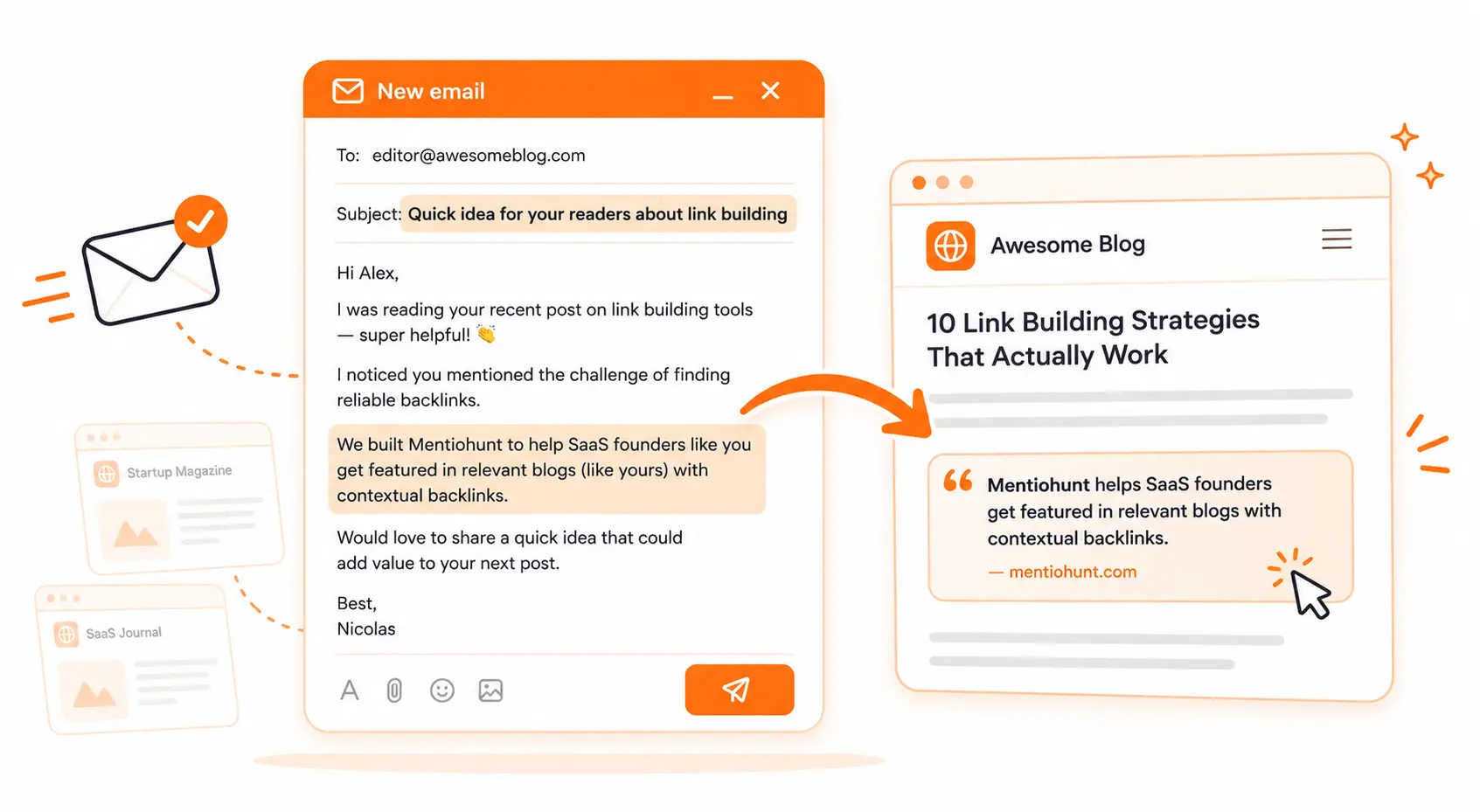
Search "guest post outreach templates" and you'll find the same thing five times: a numbered list of email bodies, ranked one through however many, with no explanation of which one to use when. That works if you only ever pitch one kind of guest post. Most people don't.
A cold pitch to a stranger, a pitch to someone whose posts you've actually been reading, and a pitch built around a gap you noticed in their content are three different emails. Sending the same one for all three is the fastest way to sound templated — even when the writing itself is good.
Why the same guest post template doesn't work twice
Most guest post templates online assume one situation: no relationship, generic angle, "can I contribute to your blog?" That's the easiest template to write, which is probably why it's the one that gets published most often. It's also the weakest one, because it gives the editor nothing specific to say yes to.
Real guest post outreach splits into a handful of distinct situations, and each one calls for a different opening and a different ask.
| Situation | What you're working with | The ask |
|---|---|---|
| Cold pitch | No prior relationship, found the site through research | Pitch one specific idea |
| Warm pitch | Read several of their posts, maybe engaged before | Pitch, referencing the pattern you noticed |
| Content-gap pitch | Site covers the topic but missed an angle | Point out the gap, offer to fill it |
| Broken-link crossover | Found a broken or outdated link on their site | Offer a full contributed post, not just a link fix |
| Follow-up | Sent one of the above, heard nothing back | Add something new, don't just check in |
Picking the wrong one out of habit is the most common way to waste a good prospect. A content-gap pitch to someone who's never heard of you reads as presumptuous; a cold-pitch template sent to someone whose newsletter you've replied to before reads as impersonal.
The 5 templates
Each of these assumes you've actually looked at the site — not skimmed the homepage for thirty seconds. The reference in the first line is what tells an editor this isn't a mail-merge.
Cold pitch
Use this when you found the site through research and have no prior interaction with the owner or editor.
Hi Marcus,
I run Capsule — we build a lightweight CRM for small B2B sales teams. Came across GrowthHackers while researching outreach systems for early-stage teams, and your piece on keeping cold volume manageable without burning prospects was one of the more useful breakdowns I've read on it.
I'd like to write a guest post on email deliverability setup for SaaS founders. My angle: most early-stage teams don't realize their cold outreach domain is affecting their product email reputation until it's already a problem — and the fix takes under an hour.
Would that work for you?
Tom
One idea, not a menu. A specific angle proves you thought about their audience, not just their domain rating. Pitching sites with a live "write for us" or contributor page is what moves a cold pitch from a guess to a reasonable bet.
Typical benchmark
The gap is personalization, not volume. A cold pitch with a real reference to their work competes with warm outreach; a cold pitch without one sits closer to spam.
Warm pitch
Use this when you've read multiple posts on the site, not just the one you're referencing — the difference between "I found your blog" and "I've been reading your blog."
Hi Sarah,
Your last three posts on cold outreach — the volume one, the personalization-at-scale one, and last week's on subject line testing — have been useful reads. The subject line piece especially; I hadn't seen the send-time data broken out like that before.
There's a related gap I think your readers would want covered: what happens after the email lands, specifically deliverability setup for a new sending domain. Most guides jump straight to copy and skip this, and it's usually the thing that quietly tanks reply rates before the copy even matters.
Want me to write it up?
Tom
Referencing a pattern across posts, not just one, signals real familiarity. It's also harder to fake, which is exactly why it lands better than a single-post reference.
Typical benchmark
An existing touchpoint doesn't have to mean a real conversation — reading enough of someone's work to reference a pattern across posts, not one, gets you most of the way there.
Content-gap pitch
Use this when the site already covers your topic area but is missing a specific angle — not "can I write for you," but "here's what your readers don't have yet."
Hi Priya,
You've got solid coverage of cold outreach — templates, timing, follow-up cadence. One thing I didn't see across any of those posts: how sending domain setup affects deliverability before a single email goes out. It's upstream of everything else you've written about, and readers scaling past a few hundred sends a week usually hit it without warning.
Happy to write it up if it's a fit — I can send a short outline first if that's easier to evaluate.
Tom
This is the highest-converting angle of the five, because the ask isn't "let me contribute" — it's "here's a hole in what you've already built, and I can fill it." It requires actually reading their existing coverage first, which most senders skip.
Typical benchmark
"Advanced personalization" in the data is exactly this: a pitch built on something specific to the recipient, not a name inserted into a fixed template.
Broken-link crossover
Use this when you find a broken or outdated link inside an existing post, but instead of just offering a replacement link, you pitch a full guest post built around the same gap.
Hi Marcus,
Quick flag: the link to Boomerang's warm-up guide in your "Email Domain Warm-Up" post is dead — 404s as of this week.
Beyond the fix, that section stops short of a question readers probably have next: how to set up a separate sending subdomain so outreach volume doesn't affect your main domain's reputation. Rather than just offering a link swap, I'd rather write the fuller piece — happy to cover the broken-link fix in it too, so you're not dealing with two separate things.
Let me know if that's worth a draft.
Tom
Ranking guest post guides almost never cover this scenario — they treat broken-link outreach and guest post pitching as two separate playbooks. Leading with a real fix earns the attention; the bigger ask that follows is easier to grant because you already did something useful first.
Typical benchmark
Broken link outreach already reply-rates above average cold outreach on its own — leading with it before the bigger guest post ask borrows that trust.
Follow-up
Send this four to six days after any of the above if you haven't heard back.
Hi Priya,
Following up on my note from a few days ago.
One thing I should have mentioned: the piece would also cover how to check inbox placement before scaling sends, which ties into a couple of the deliverability questions you've gotten in your post comments. Wanted to flag it in case it changes how it fits your coverage.
Happy to answer anything before you decide.
Tom
Never write "just checking in" — it tells the editor you have nothing new to add. A follow-up needs its own reason to exist, not just a reminder that the first email is sitting in their inbox.
Typical benchmark
Skipping the follow-up leaves close to half of your potential replies on the table.
Deciding: pitch an idea, or ask for an outline first?
Smaller or less formal blogs usually decide fast off a one-paragraph pitch — send the idea, wait for a yes, then write. Sites with a visible editorial process (a style guide, a contributor page with submission steps, an editor who reviews outlines before drafts) expect you to ask which they'd rather see before you write anything.
The simple rule: if the site has a dedicated "write for us" or contributor page, follow whatever process it describes. If it doesn't, pitch the idea in one paragraph and let the reply tell you whether they want an outline, a draft, or just a yes.
Personalization checklist before sending
- Does the first line reference something specific — a post, a claim, a broken link, a gap — not the site in general?
- Is there exactly one idea and one ask, phrased so it's easy to say yes or no to?
- Would this email make sense only to this recipient, or could it go to any blog in the niche?
- Any leftover brackets, placeholder names, or a subject line that doesn't match the body?
If you can't answer all four confidently, it's worth another pass before it goes out.
Common mistakes that kill guest post replies
- Pitching three ideas instead of one. A list of options looks generous but forces the editor to do the narrowing you should have done.
- No reason the pitch is relevant right now. "I'd like to write for you" with no connection to something current on their site reads as a form letter.
- Assuming every blog takes guest posts. Some sites only accept resource-page suggestions or don't run contributed content at all — pitching a guest post to one of those wastes the prospect before you've even started.
Templates get you the words. They don't get you the site.
The templates above solve the writing problem. They don't solve the harder one: finding sites that actually accept guest posts, where your specific idea is a genuine fit for what they already publish. That's usually where most of the time in outreach actually goes — not writing the email, but figuring out who's worth sending it to. Mentiohunt surfaces sites where your article has a real reason to be pitched, along with a fit rationale, so you know which of these five templates to reach for before you write a word.
What counts as a good angle also shifts by industry — see how guest post prospecting plays out for law firms, B2B SaaS, insurance agencies, and contractors.

Founder at Mentiohunt. Building distribution tools for founders and small marketing teams. Writes about backlink building and founder-led growth.
@nicolasmore_