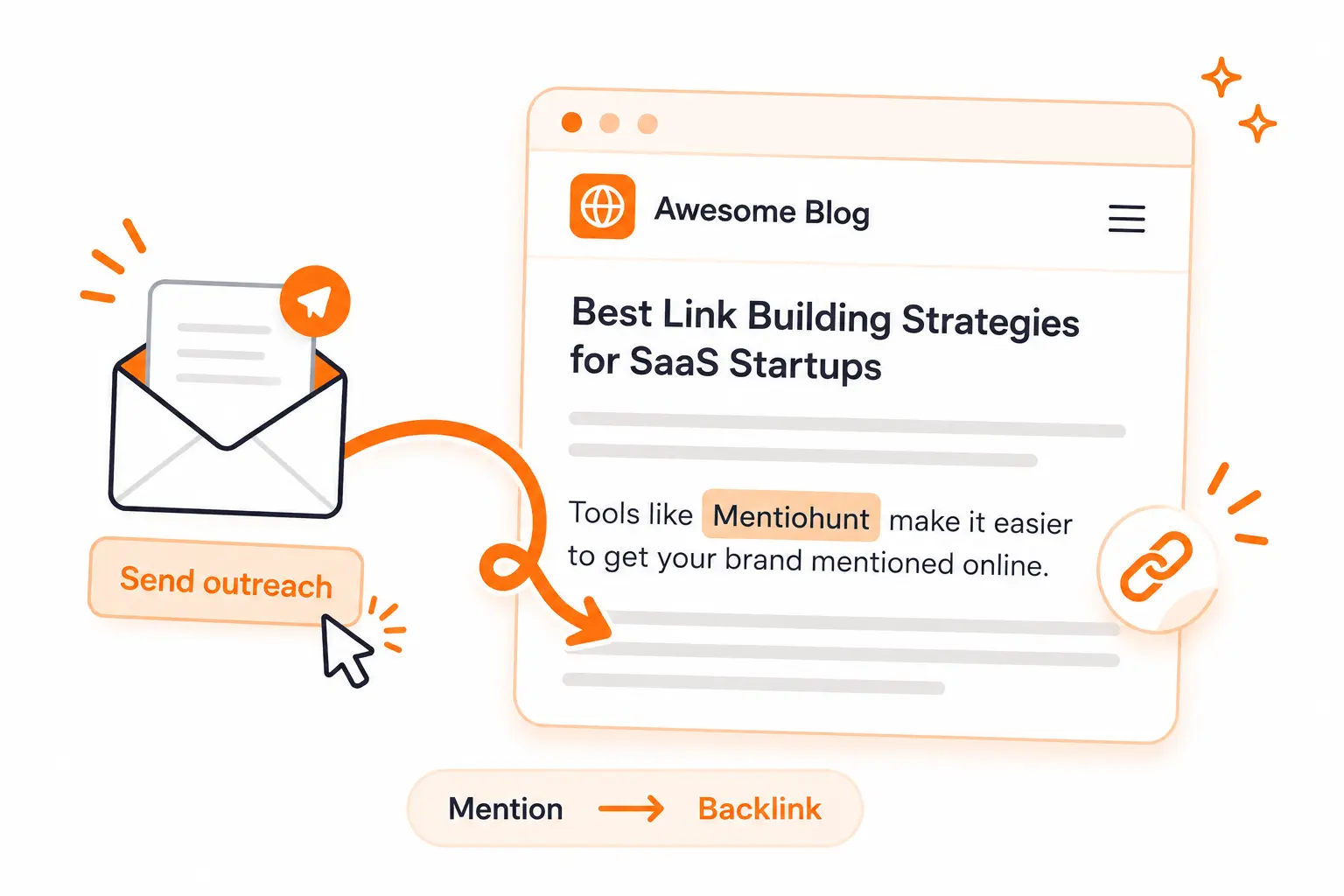
Most backlink request emails get one read and a delete, not because the writing is bad, but because the ask arrives before any reason to say yes. The fix isn't a better-written template — it's sending the right template for what you actually found on their site, and skipping the ask entirely when the fit isn't there yet.
Which backlink request actually fits your situation
Before picking a template, figure out what you're actually looking at. Each situation below calls for a different opening and a different ask.
| What you found | Template to use | The ask |
|---|---|---|
| They already named you, your product, or your data — unlinked | Unlinked mention request | Add a link to an existing mention |
| You have a specific page that fits a specific spot on theirs | Direct backlink request | Add a link to your page |
| No existing mention, but real audience overlap | Partnership request | No hard ask — open the relationship |
| You sent one of the above and heard nothing | Follow-up | Add something new, don't just check in |
The unlinked mention request is the one most template roundups bury near the bottom of a list of fifteen or twenty. It deserves to go first — you're not asking a stranger for anything, you're asking someone who already referenced you to finish the job.
The four emails
Unlinked mention
Use this when someone already named your product, cited your data, or referenced your content — without linking it.
Hi Dana,
Saw Capsule mentioned in your roundup of CRM tools for small sales teams — appreciate the shoutout.
Noticed it isn't linked yet. Would you mind pointing it to capsule.io? Happy to send over anything else that'd be useful for the post.
Tom
Don't send this if the mention is buried in a comment section or a low-traffic page you found by accident — confirm it's on a page worth having a link from before you ask.
Typical benchmark
The gap is the editorial decision. A site that already named you has decided you're worth referencing — you're asking for a link, not a mention.
Direct backlink request
Use this when you have a genuinely useful page and a specific, visible reason it belongs on theirs — not a general "we'd love to be featured" pitch.
Hi Priya,
Read your guide on email domain warm-up — the section on daily sending limits was a useful breakdown.
One gap: setting up a separate sending subdomain so outreach volume doesn't affect a team's main product email reputation. We wrote a guide that covers exactly that: capsule.io/blog/email-deliverability
Would it be worth adding as a resource in that section?
Tom
Don't send this if you can't point to the exact section, paragraph, or gap your page fills. "We think your readers would like our resource" without naming where it fits is the version that gets deleted.
Typical benchmark
Partnership opener
Use this when a site covers your space and has real audience overlap, but hasn't mentioned you and there's no natural gap to point to yet.
Hi Marcus,
I run Capsule — a lightweight CRM for small B2B sales teams. Came across your post on outreach systems for early-stage teams and wanted to say it's one of the better breakdowns I've seen on keeping volume manageable without burning through prospects.
We've been working through a related problem on the deliverability side. Wrote up what we learned here, in case it's useful: capsule.io/blog/email-deliverability
No ask here — just wanted to flag it in case it's relevant to what you cover.
Tom
Skip the ask entirely. This email exists to make a future request land better, not to get a link today.
Typical benchmark
Follow-up
Send this four to six days after any of the above, if you haven't heard back.
Hi Priya,
Following up on my note from a few days ago.
One thing I should have mentioned: the guide also covers checking whether outreach emails land in inbox vs. spam before scaling sends — often the next question readers have after the warm-up section.
Happy to answer anything.
Tom
Never write "just checking in" on its own — it tells the reader you have nothing new to add. Give them a reason to reconsider, not a reminder.
Typical benchmark
Skipping this step leaves most of your potential replies on the table.
What makes a backlink request read as spam
- Leading with your domain metrics instead of their page. Opening with your DR or traffic numbers signals a mass send before the reader gets to the actual pitch.
- Asking before giving a reason. If the first sentence is the ask, there's no context for why it's worth a yes.
- No specific placement suggested. "Consider linking to us somewhere" is harder to act on than naming the exact section or sentence.
- Framing it as a trade. "I'll link to you if you link to me" reads as a swap, not a recommendation — and reciprocal exchanges done at scale carry their own risk.
Before you send: quick checklist
- Does the first line reference something specific — a mention, a section, a page — not their site in general?
- Is the ask one sentence, answerable with a yes or no?
- Would this email make sense only to this recipient, or could it go to anyone in the niche?
- If it's a follow-up, does it add something new instead of just checking in?
If any of those come back no, it's worth another pass before sending.
Writing the email is the easy half. The harder problem is finding the right site and the right existing mention or gap to reference in the first place — that's usually where most of the time in backlink outreach actually goes. Mentiohunt surfaces opportunities like this with a fit rationale attached, so you know why a site is worth a request before you write one.
Which sites are worth requesting from also depends on the industry — see how this plays out for law firms, B2B SaaS, insurance agencies, and contractors.

Founder at Mentiohunt. Building distribution tools for founders and small marketing teams. Writes about backlink building and founder-led growth.
@nicolasmore_