Prefer AI? Summarize this with ChatGPT,
Claude,
Google AI Overview, or
Perplexity.
Most link building services say they're white hat. So do many of the rate cards that land in your inbox. So what does "white hat" actually mean, and how do you tell when a deal isn't?
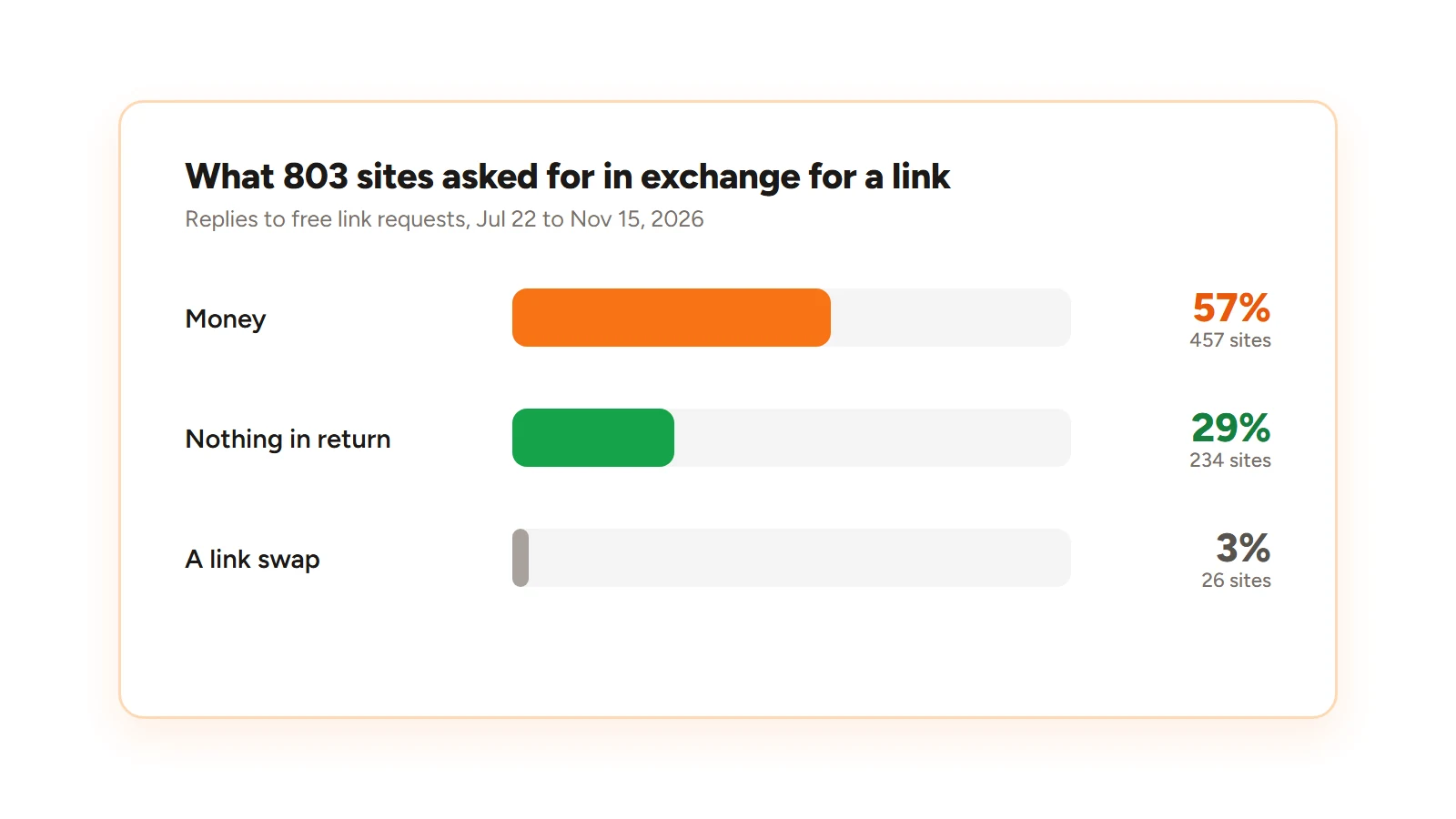
We had a useful way to check. Between July 22 and November 15, 2026, Mentiohunt sent outreach for the products using it, and every email asked for the same thing: a free editorial mention. 803 sites wrote back with a real answer. Here is what they asked for in return, sorted by Google's own rules.
803 replies to free link requests, Jul 22 – Nov 15, 2026
TL;DR: White hat link building means the site chooses to link to you, and nothing changes hands. Google's spam policies list paying for links, trading goods for links and link swaps as link spam, and only accept paid links that are marked as ads. In our data, 57% of sites asked for money and only 29% asked for nothing, so a clean link takes more asking, not more spending.
What white hat link building actually means
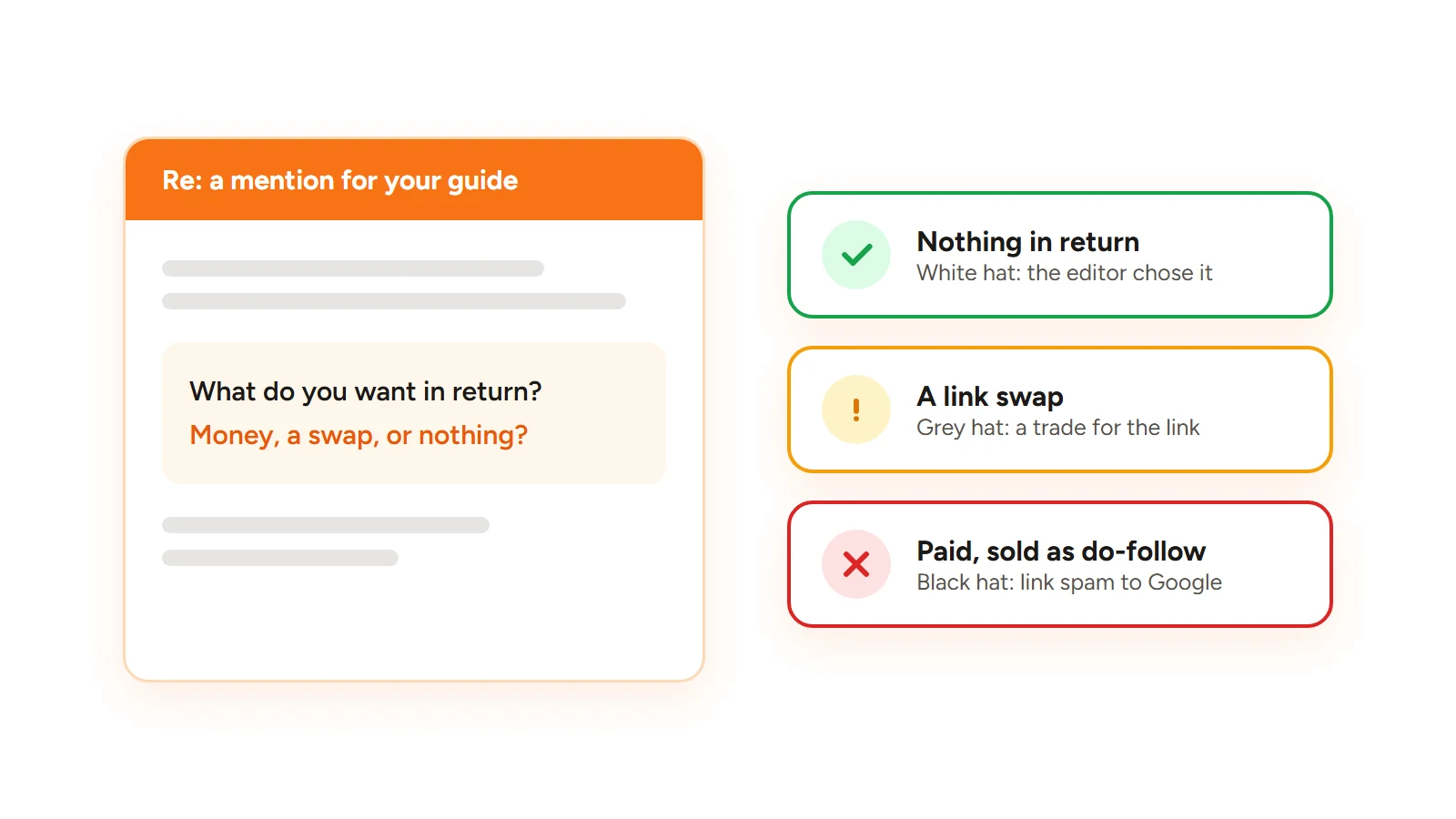
White hat link building is earning links that a site decides to give you because your page helps its readers. You can ask, pitch and follow up. What you can't do is pay, trade or swap for the link.
Moz's beginner's guide to link building calls this link "earning": every campaign has to start with a page worth linking to, and asking gets much easier once you have one.
That definition isn't a matter of taste. Google's spam policies list what counts as link spam, and the list is specific:
- Exchanging money for links, or posts that contain links
- Exchanging goods or services for links
- Sending someone a product in exchange for them writing about it and including a link
- Excessive link exchanges ("Link to me and I'll link to you")
Everything else you do to get a link, from finding the right page to writing a good email, is fine. The question is only what the site gets in return.
White, grey and black hat side by side
| Practice | Where it sits | Why |
|---|---|---|
| A site links to your guide after you pitch it | White hat | The editor chose it and nothing changed hands |
| A resource page adds your tool after you suggest it | White hat | Same: the site decides on fit |
| A site adds a link to your page where it mentions you without one | White hat | It's a correction, not a trade |
A paid placement marked rel="sponsored" | Allowed, as advertising | Google accepts it because it passes no ranking credit |
| A link swap arranged by email | Grey hat | Google lists excessive link exchanges as link spam |
| A free product or account in return for a review with a link | Grey hat | "Goods or services for links" is on Google's list |
| A paid guest post or link sold as do-follow | Black hat | Paying for a link that passes ranking credit is link spam |
| Private blog networks and sites that publish any topic for a fee | Black hat | The links exist only to sell ranking credit |
The paid row in the middle is the one people miss. Google's policy says buying links for advertising is a normal part of the web, and it's fine as long as the link carries rel="sponsored" or rel="nofollow". That makes it an ad you can buy for the readers. It doesn't make it a link that helps you rank.
Google's former head of webspam, Matt Cutts, explains why a paid link is treated differently from any other ad:
What 803 sites asked for when we requested a free link
| What the reply asked for | Sites | Share of replies |
|---|---|---|
| Money (a price, a rate card or "what's your budget?") | 457 | 57% |
| Nothing in return: a yes, a question, a request for details or a polite no | 234 | 29% |
| A link swap | 26 | 3% |
Of the 457 sites that asked for money:
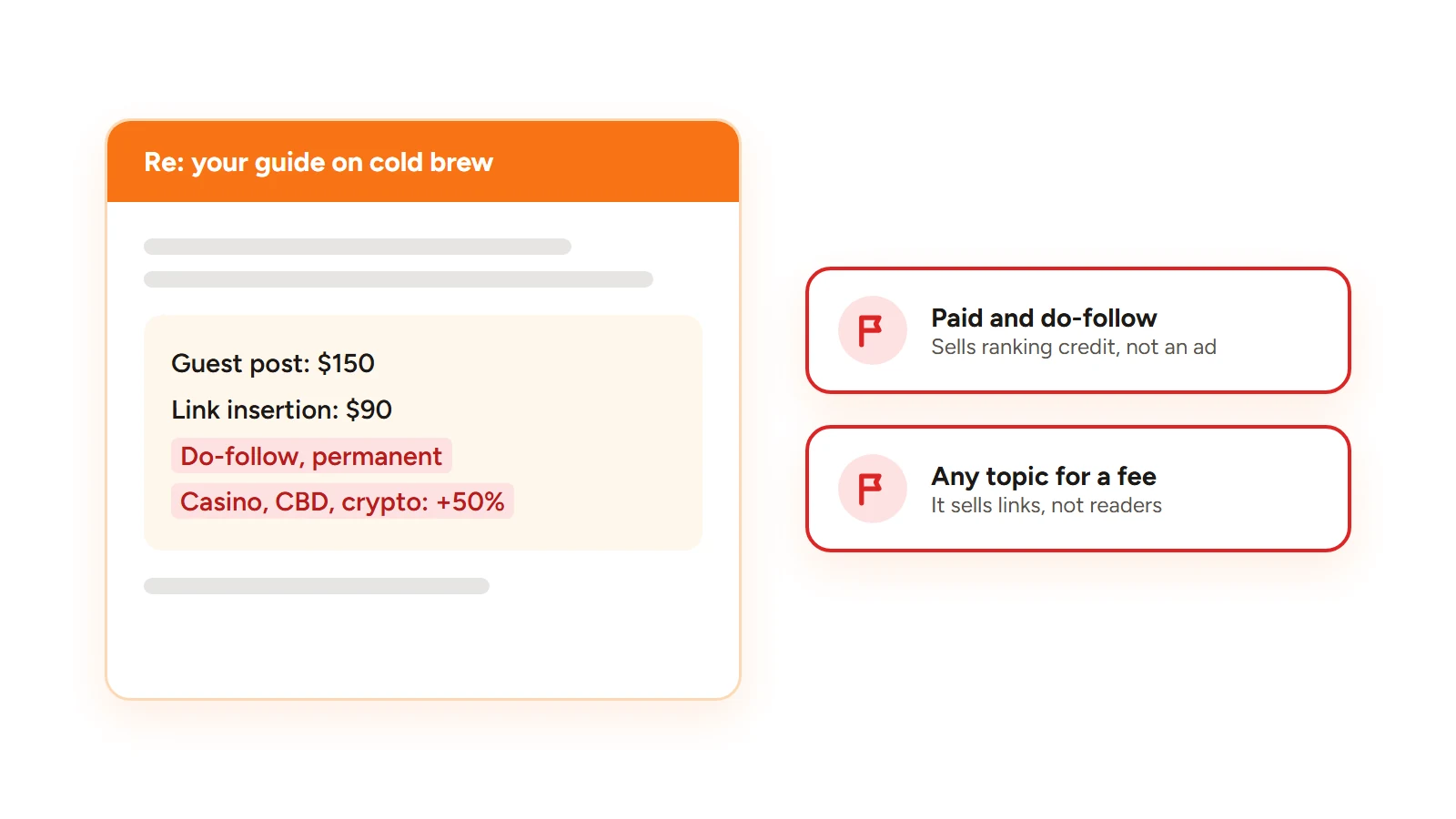
- 212 (46%) promised a do-follow link. That's the version Google's policy rules out for a paid link.
- 137 (30%) offered casino, CBD, gambling, betting or crypto rates in the same reply. A site that publishes for any topic is selling links, not readers.
How we counted: one count per site, using its human replies only. Bounces, auto-replies and out-of-office messages are excluded. An AI check flags replies that quote a price. We found swap requests by keyword, then read all 47 matches by hand: 26 proposed a swap and 18 refused one. The rows don't add up to 803: a few sites offered a price or a swap in the same reply, and the rest declined outright or asked for something else. Prices are in our link building cost breakdown.
The refusals were telling. Almost every site that wrote "no link exchanges" offered a paid placement in the same email. "We don't do swaps" rarely meant "we only link on merit". It usually meant "we only sell".
How to tell a clean link from a grey one when the reply arrives
Four questions sort almost any reply:
- Does money, a product or a link change hands? If yes, it isn't white hat, however the email describes it.
- If you pay, will the link be marked
rel="sponsored"? A site that refuses is selling ranking credit, not an ad. - Would this site link to you if you hadn't asked? Your page should fit what its readers came for.
- Does it publish any topic for a fee? A price list with casino and crypto rates answers the question.
When a reply proposes a swap, you can say no without closing the door:
Hi Alex,
Thanks for getting back to me. We don't do link exchanges, so I'll pass on that part.
If the guide still looks useful for your readers, I'd be glad to see it in the article on its own merits. And if there's a section where a quote or a data point from us would help, happy to send one.
Thanks either way.
White hat link building services: what to ask before you hire one
Plenty of services sell "white hat links". The label costs nothing, so check the method. Three questions get to it quickly:
- How do you get the link? "Outreach" can mean asking for a free mention, or paying the site on your behalf.
- Can you show me a sent email and the reply? A real editorial process leaves a paper trail.
- What share of your placements are paid? If a service guarantees a fixed number of links every month, some of them usually are.
The link building services guide has the full list of questions to ask before you pay, plus what each kind of service costs.
Where white hat links come from
Ahrefs lists seven white hat techniques SEOs still use, from broken link building to turning unlinked brand mentions into links. Our outreach data shows which of them meet the fewest price quotes. In our cost study, resource pages and sites that already mentioned the brand were the least likely to answer with a price. Guest post pitches and sites that linked to a competitor were the most likely, and many of the latter had sold that link in the first place.
For the methods themselves, see the guide on how to find backlink opportunities, the resource page link building guide, and the unlinked brand mention finder for mentions that are missing a link.
Is white hat slower? Yes, and that's the cost
Paying is faster. A rate card turns into a live link in days, while free outreach gets a yes from a minority of the sites you contact. Only 29% of the sites that replied to us asked for nothing in return, and not all of those said yes.
What you get for the extra effort is a link that doesn't depend on Google missing it. Google's December 2022 link spam update said its systems can detect sites that buy links and sites that sell them, and that the ranking credit those links pass can be lost. A bought link Google ignores is money spent on nothing, and you won't be told when it happens.
FAQ
Is buying backlinks illegal?
No. Buying a link is not against the law. It is against Google's spam policies when the link passes ranking credit. A paid link is allowed when it is marked rel="sponsored" or rel="nofollow", which tells Google it is an ad.
Are link exchanges white hat?
Not when they are arranged for rankings. Google lists excessive link exchanges as link spam. Two sites that link to each other because each page genuinely helps the other's readers is normal. A swap negotiated by email in return for a link is the grey area.
Is guest posting white hat?
Yes, when you write for the site's readers and the editor decides whether to include a link. It stops being white hat when you pay for the post, or when posts exist mainly to carry links with keyword-rich anchor text.
Does Google penalize paid links?
Google says its systems detect sites that buy and sell links, and the links lose the ranking credit they would pass. Repeated or large-scale link schemes can also lead to a manual action against the site.
Is white hat link building worth it?
For a small business that plans to keep its site for years, yes. It takes more asking: only 29% of the sites that replied to us asked for nothing. But you don't pay for links that may stop counting.
The takeaway
White hat isn't a tactic. It's a rule about what changes hands: if money, a product or a link is the price of the link, it isn't white hat, whatever the email calls it. Expect more than half of the replies to free outreach to ask for money, and plan for more asking rather than more spending.
That's how Mentiohunt's automated link building tool works. It finds sites where your pages fit and sends backlink outreach that asks for a free mention, never a paid one, on a flat monthly plan. When a reply quotes a price, it's flagged in your dashboard and the sequence stops, so you decide how to answer. You take over every conversation at the first reply, and the site still decides whether to link.
Founder at Mentiohunt. Building distribution tools for founders and small marketing teams. Writes about backlink building and founder-led growth.
Turn this guide into a weekly opportunity queue.
Mentiohunt finds relevant backlink opportunities from your site, competitors and keywords, explains why each one fits, and runs the outreach through the first reply. The preview is free and sends nothing.